Plush Toy Safety Standards Explained: EN 71, ASTM F963, and CPSIA
Safety is the one area of plush manufacturing where getting it wrong is not a quality complaint — it is a recall, a pulled order, and a public listing under your brand's name. And it trips up more buyers than it should, because there is no single global "toy safety standard" to comply with. There is a set of market-specific rules, the requirements are stricter than most people expect, and for plush they are strictest of all, because plush is usually aimed at the youngest, most vulnerable children.
This is a plain-English explanation of the three standards you will hear most — EN 71, ASTM F963, and CPSIA — what each actually covers, the other markets that matter, what physically gets tested on a plush toy, and how to build compliance in from the design stage instead of discovering it after thousands of units have shipped. It is current as of 2026, including the European Union's new Toy Safety Regulation, which changed the EU framework at the start of the year.
Why Plush Toy Safety Standards Matter
Two facts shape everything that follows. First, most plush either targets or reaches young children, which puts it in the strictest regulatory tier — the one built around choking, small parts, and chemical exposure for kids under three. Second, the party legally responsible for a compliance failure is the brand or importer of record, not the factory. When a toy is recalled, the company named in the public database is the one whose name is on the box. The commercial and reputational cost lands there.
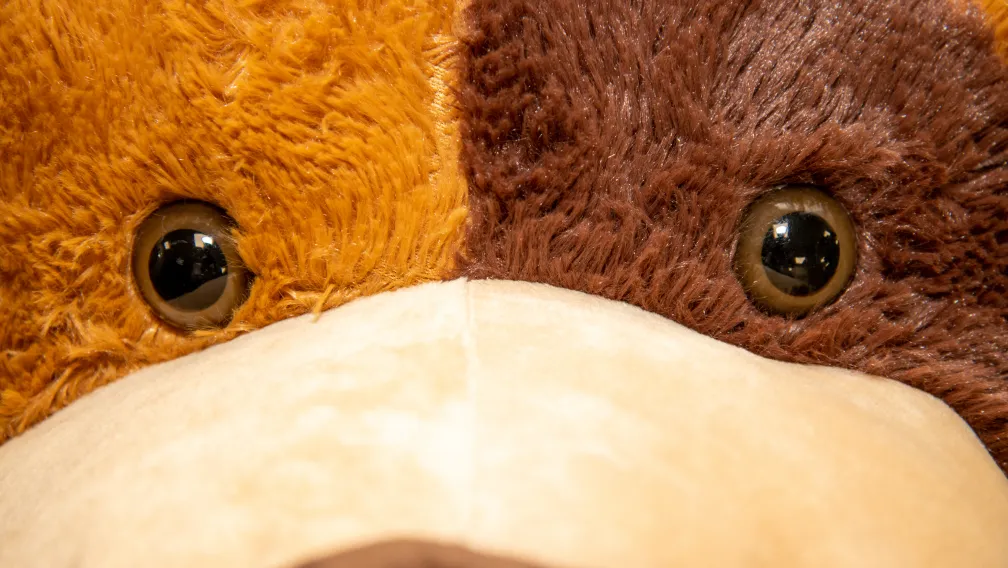
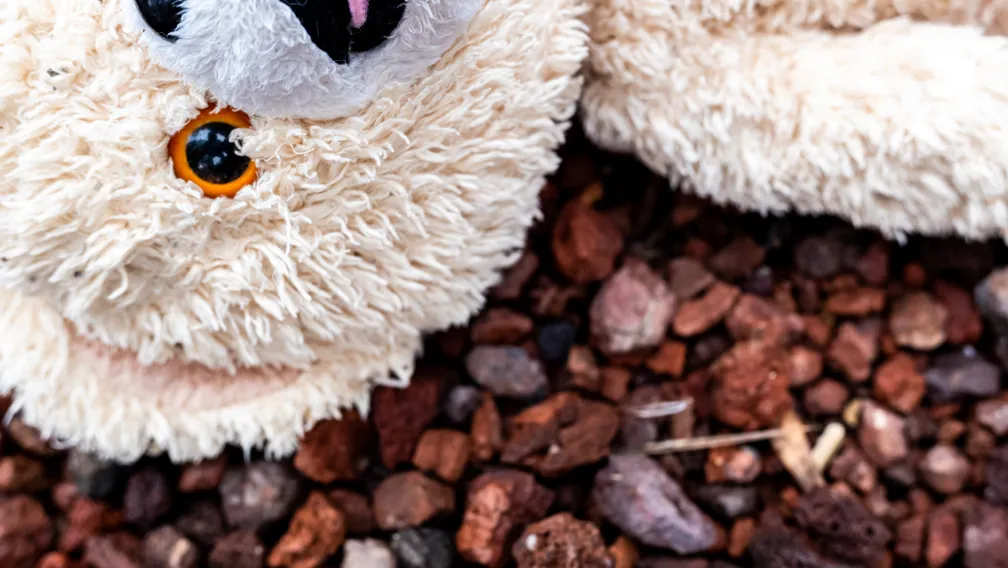
It is also worth knowing where plush actually fails, because it is rarely the soft body. Fabric and fiberfill are low-risk on their own. Risk concentrates in anything hard, small, or detachable attached to them: plastic or glass safety eyes and noses, button-cell batteries in sound or light features, rigid inserts such as cooling packs or rattles, and beads or trims small enough to come loose and be swallowed. Most plush recalls trace back to one of those components. Catching a hazard at design and sampling is far cheaper than catching it after the container lands, which is the entire argument for treating safety as a design input rather than a final-stage checkbox.
Age grading is the lever that quietly decides how strict the rules are. A toy marketed for children under three faces the full small-parts regime, because that age group puts almost everything in their mouths; the same toy graded for older children faces a different, lighter set of requirements. This is not a loophole to exploit — a plush toy that will obviously appeal to a toddler must be built to the under-three standard regardless of how it is labeled, and regulators look at the realistic user, not just the stated one. But it does mean age grading is a real design decision with cost and testing consequences, and it should be settled early, honestly, and consistently across every market you sell into.
Safety Standards Map to Markets, Not Products
The most common misunderstanding is treating safety as a single specification you either meet or do not. In reality, the destination market dictates which standard applies. The same plush toy may need to meet EN 71 to sell in the EU, ASTM F963 and CPSIA to sell in the US, GB 6675 in China, and so on. Selling the same design into several markets generally means several separate test programs, each with its own cost.
The good news is that the major standards overlap heavily in intent — they all screen for choking and small parts, sharp edges and points, flammability, and hazardous chemicals. Where they differ is in the exact limits, the test methods, and the paperwork required to prove conformity. So the work is less about redesigning a toy for each market and more about testing and documenting it correctly for each one.
Selling Plush in the US: CPSIA and ASTM F963
For the US market, the governing law is the Consumer Product Safety Improvement Act of 2008 (CPSIA), enforced by the Consumer Product Safety Commission (CPSC). CPSIA does several things at once: it makes the ASTM F963 toy standard legally mandatory, sets strict chemical limits, requires tracking labels, and mandates third-party testing.
The current mandatory version is ASTM F963-23, which took effect on April 20, 2024, replacing the older F963-17, and applies to toys for children under 14. It covers mechanical and physical hazards (small parts, sharp edges and points, seam and attachment strength), flammability, and the migration of heavy elements. On top of the standard itself, CPSIA imposes its own well-known limits: total lead content capped at 100 ppm in accessible substrate and 90 ppm in surface coatings and paint, and eight phthalates restricted to 0.1 percent in children's toys. It also requires permanent tracking labels under Section 103, and — critically — testing at a CPSC-accepted third-party laboratory, backed by a Children's Product Certificate (CPC) that documents the results. One recent addition worth flagging: a dedicated water bead toy safety standard took effect on March 12, 2026, which matters for any plush that incorporates water beads. Our overview of safety and compliance lays out how these US requirements are handled per order.
A few practical notes on the US paperwork, because it is where importers most often get caught. The Children's Product Certificate is not optional and not a formality — it is the document that certifies, based on passing third-party test reports, that the product meets every applicable rule, and US Customs and the CPSC can request it at the border. The tracking label required under Section 103 must be permanent and on both the product and its packaging, carrying enough information to identify the manufacturer, the production batch, and the date and place of manufacture, so that a future problem can be traced to a specific run. And the testing must be done at a laboratory the CPSC has specifically accepted for the relevant tests — a general ISO-accredited lab is not automatically sufficient. None of this is exotic for an experienced factory, but a buyer who assumes a supplier "handles compliance" without confirming the CPC, the tracking label, and the accepted-lab reports is taking on a risk that surfaces only at the worst moment.
Selling Plush in the EU: EN 71 and the New Toy Safety Regulation
For the EU, toys must carry the CE marking and be backed by an EU Declaration of Conformity, with conformity normally demonstrated through the EN 71 series of harmonized standards. The parts most relevant to plush are EN 71-1 (mechanical and physical properties), EN 71-2 (flammability), and EN 71-3 (migration of certain elements). These are the EU equivalents of the mechanical, flammability, and chemical screens you see in ASTM F963.
The significant change for 2026 is structural. Regulation (EU) 2025/2509, the new EU Toy Safety Regulation, was published in the Official Journal on December 12, 2025, entered into force on January 1, 2026, and replaces the old Toy Safety Directive 2009/48/EC. It becomes fully applicable on August 1, 2030, giving the industry a 54-month transition during which toys meeting the old Directive can still be placed on the market. Moving from a Directive to a Regulation means the rules now apply uniformly across every member state without separate national implementation. The substance is stricter too: it expands chemical restrictions well beyond the previous carcinogenic, mutagenic, and reprotoxic (CMR) substances to cover endocrine disruptors, PFAS, and skin and respiratory sensitizers, and it introduces a Digital Product Passport for traceability along with tighter obligations on importers and online marketplaces. The EN 71 standards are being revised to align — EN 71-1:2026 has already been published. For exporters, nothing forces a change before 2030, but any new long-life program is smart to design toward the stricter chemical rules now rather than re-engineer later.
There is one more shift in 2025/2509 that plush exporters should not overlook: the Digital Product Passport and the tightened role it gives customs and online marketplaces. As the system comes into force, EU customs will be able to check a product's passport against a central registry at the border, and online marketplaces carry new obligations to verify that what they list is compliant. For a B2B manufacturer, the takeaway is that traceability documentation — the same bill of materials, test reports, and batch records that good factories already keep — becomes part of market access rather than just internal record-keeping. Building a clean documentation trail now is cheaper than assembling one retroactively when a marketplace or a customs authority asks for it.
Other Major Markets: UK, China, Australia, and Japan
Beyond the US and EU, the markets a plush exporter meets most often each have their own framework. The UK uses the Toys (Safety) Regulations 2011, with UKCA or CE marking accepted for the Great Britain market and Northern Ireland continuing to follow EU rules. China's national toy standard is GB 6675. Australia and New Zealand work to AS/NZS 8124, which mirrors the international ISO 8124 series. Japan uses the ST standard and its ST mark. And across the EU specifically, the REACH regulation governs chemical substances independently of the toy rules.
The practical point is simple: confirm every destination market before production, not after. A toy built and tested only for the US can stall at an EU border, and a late-discovered market means a late-discovered test program — extra cost and weeks of delay on an order that was otherwise ready to ship.
What Actually Gets Tested on a Plush Toy
Underneath the standard names, the physical testing on a plush toy is fairly consistent across markets. The checks that matter most:
- Small parts and choking — any detachable component on a toy for under-3s must not fit through the standard small-parts cylinder, both as supplied and after abuse testing.
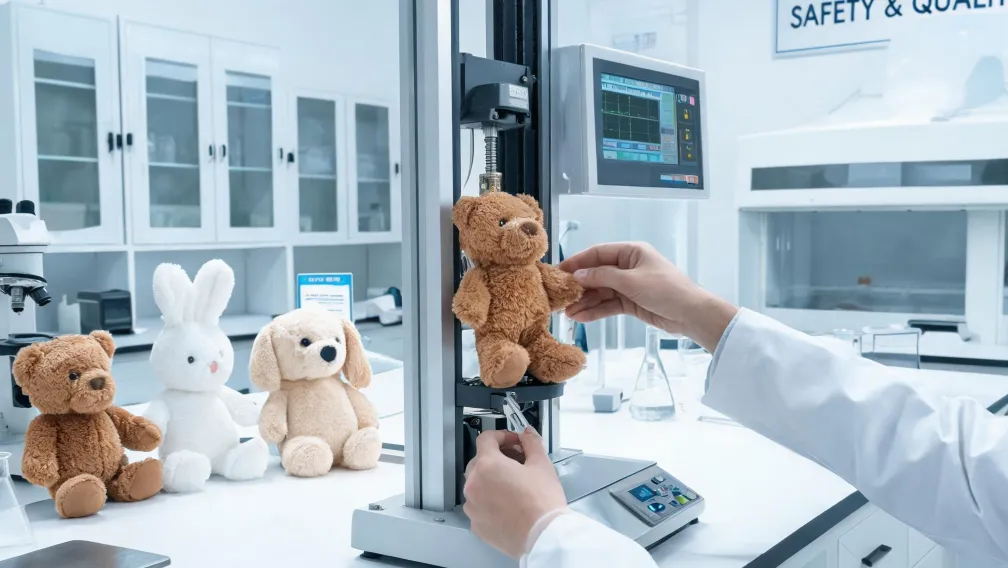
- Use-and-abuse testing — the toy is dropped, twisted (torque), pulled (tension), and compressed to simulate real handling, then re-checked for parts that have come loose or edges that have turned sharp.
- Seam and attachment strength — seams and attached features like eyes and limbs must withstand specified pull forces without releasing.
- Flammability — the surface textile is tested for flammability against the relevant market limit.
- Chemical — migration of heavy elements (lead, cadmium, and others), phthalate content, and any market-restricted substances.
- Labeling — correct age grading, required warnings, and traceability or tracking labels for the destination market.
For plush specifically, the failures cluster around the detachable parts and the seams rather than the fabric, which is why the choice between embroidered features and glue-on plastic parts, and the strength of every attachment, deserves attention at the design stage. The fill matters too: contained, sewn-in fills behave very differently from loose or rigid inserts, which is part of why weighted plush uses pellets held inside stitched chambers rather than a removable hard component.
Why Testing Is Per Batch, Not Just Per Design
A point buyers often miss: testing a design once is not the same as keeping it compliant. The real question is whether the batch that ships matches the sample that passed. A reputable factory tests per production batch at accredited third-party laboratories — SGS, Bureau Veritas, and Intertek are the names you will see — and issues reports tied to the specific batch, not just the original design.
That batch-level discipline is what catches the most dangerous failure mode: a factory that tests the approved sample, then quietly swaps a cheaper fabric, a different dye lot, or an alternative component in the bulk run, shipping product that was never actually tested. Testing is a separate cost line — quoted per design and per market, and largely fixed regardless of order size — which is exactly why it weighs more heavily on small runs and why it belongs in your landed-cost math from the start. Our breakdown of custom plush toy cost covers how testing sits alongside the other cost layers.
Keeping the bulk run identical to the tested sample is partly a sourcing question and partly a process one. The sourcing side is locking your bill of materials at approval — the exact fabric, fill, eyes, thread, and accessories — so nothing substitutes silently later. The process side is having the same team run sampling and production in the same facility, inspecting each batch against the physical approved sample rather than a photo. When those two things are in place, batch testing becomes confirmation of a controlled process rather than a gamble on whether the factory held the line. When they are not, even a design that passed cleanly on day one can drift into non-compliance by the time it ships, which is how well-intentioned programs end up in a recall database.
Building Compliance In From the Design Stage
The cheapest place to handle safety is the design review, long before any fabric is cut. The concrete moves that prevent most plush failures: prefer embroidered eyes and noses over glue-on plastic parts for any toy that may reach a child under three; engineer and securely fasten — or design out entirely — any hard or detachable insert; choose fabrics and fills with known, compliant chemical profiles rather than discovering a chemical failure after production; eliminate small detachable trims that could come loose; and plan age grading, warnings, and labels for each destination market up front.
This is also where the choice of manufacturer matters most. A factory that builds to the destination standard from the start, keeps design and production under one roof so the tested sample stays the production reference, and tests per batch removes most of the recall risk before it can form. Our materials range is selected with these requirements in mind, and as a custom plush manufacturer we treat the safety review as the first step of a project, not the last. If you are planning a plush program and want the compliance path mapped for your target markets, tell us about your project and we will lay out exactly which standards and tests apply before anything goes into production.
FAQ
It depends on the destination market, not the product. The US requires compliance with the CPSIA and the ASTM F963 toy standard; the EU requires CE marking with conformity shown via the EN 71 series and, from 2026, the new Toy Safety Regulation (EU) 2025/2509. Other markets use their own — GB 6675 in China, AS/NZS 8124 in Australia and New Zealand, the ST standard in Japan, and the Toys (Safety) Regulations in the UK. Selling into several markets usually means several test programs.
EN 71 is the EU's series of harmonized toy safety standards (mechanical, flammability, chemical). ASTM F963 is the US toy safety standard. CPSIA is the US federal law that makes ASTM F963 mandatory and adds its own rules — lead and phthalate limits, tracking labels, and third-party testing. In short, EN 71 covers the EU; ASTM F963 and CPSIA together cover the US.
Yes. ASTM F963-23 became the mandatory US toy standard on April 20, 2024, replacing F963-17, and applies to toys for children under 14. All toys manufactured on or after that date must be tested to F963-23 at a CPSC-accepted third-party laboratory and backed by a Children's Product Certificate.
Published in December 2025 and in force from January 1, 2026, it replaces the old Toy Safety Directive 2009/48/EC and becomes fully applicable on August 1, 2030, with a transition period until then. It applies uniformly across all member states, expands chemical restrictions to include endocrine disruptors and PFAS, and introduces a Digital Product Passport for traceability, with stricter obligations on importers and online marketplaces.
The core checks are small parts and choking (detachable parts for under-3s must not fit the small-parts cylinder, before and after abuse), use-and-abuse testing (drop, torque, tension, compression), seam and attachment strength, flammability of the surface textile, chemical migration of heavy elements and phthalates, and correct age grading and labeling. For plush, most failures are in the detachable parts and seams, not the fabric.
Reputable manufacturers test per production batch, not just per design, at accredited third-party labs such as SGS, Bureau Veritas, or Intertek. Batch-level testing is what proves the units that shipped match the sample that passed, and it guards against fabric, dye-lot, or component swaps slipping into bulk production untested.