US vs China Plush Manufacturers: Cost, Quality, and Lead Time Compared
"Should we make our plush in China or in the US?" is one of the most common questions B2B buyers bring to us, and the honest answer is that it depends far more on your order than on any blanket rule. The two options are not really competing on the same field — a Chinese factory and a US domestic maker tend to be built for different kinds of work. This is a straight comparison of where each actually wins on cost, quality, lead time, and the practical factors around them, written from the factory side and meant to help you match the right production base to your project rather than to sell you on one answer.
A quick orientation before the detail: roughly 80 percent of the toys sold in the United States are manufactured in China, and plush is no exception. That dominance is not an accident of price alone — it reflects decades of accumulated capability in plush-specific pattern-making, materials, and skilled sewing. US domestic plush manufacturing exists and does some things very well, but it is a smaller, more specialized world. Understanding that shape is the starting point for any sensible comparison.
Where Each Is Actually Made
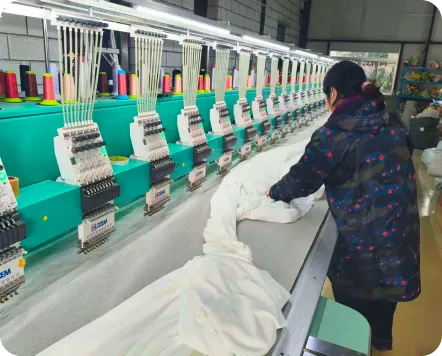
The first thing to clear up is what "made in" really means in this category. A Chinese plush factory typically runs the whole process under one roof: design, pattern-making, fabric sourcing, cutting, sewing, stuffing, finishing, and QC. The established hubs — Yangzhou and Qingdao for stuffed toys in particular — sit inside a dense supplier ecosystem where fabrics, eyes, fills, and accessories are all sourced locally and fast.
The US side splits into two groups. A handful of genuine domestic manufacturers operate real factories — companies like Beverly Hills Teddy Bear, whose California facility produces in the range of 250,000 units a year, and Douglas Cuddle Toys, a long-established brand with its own design program. Then there is a larger group of low-minimum custom services aimed at personal, promotional, and small-retail orders. One nuance worth knowing: some "Made in USA" plush is produced by importing unstuffed skins from China and then stuffing and finishing them domestically, which earns a "Made in USA with Imported Materials" label. That is a legitimate model, but it is not the same as fully domestic production, and it tells you something about how hard it is to source plush fabrics and components entirely within the US.
The scale difference is worth sitting with. A single mid-sized Chinese plush factory can comfortably exceed the annual output of a well-known US domestic maker, and there are hundreds of such factories clustered in a few provinces. That density is what lets a Chinese supplier turn a sample around in days, swap a fabric the same week, and run several client projects in parallel without bottlenecking. The US low-MOQ services solve a genuinely different problem — getting one or a few dozen pieces made quickly and locally — and they are excellent at it, but they are not built to price or produce a 10,000-piece retail line. Knowing which world your order belongs in answers most of the China-versus-US question before you compare a single number.
Cost: Unit Price, Tariffs, and Total Landed Cost
On raw unit price, China is consistently lower, and the gap is not small. Industry executives have publicly estimated that producing the same toy domestically in the US can cost up to roughly three times the Chinese figure, driven mainly by labor — plush is hand-sewn, labor-intensive work, and US wage structures simply land at a different level. Even US domestic makers acknowledge their per-piece cost runs above foreign production.
But unit price is not landed cost, and 2026 has complicated the comparison. Chinese-made toys, historically duty-free under HS heading 9503, now carry roughly 17.5 percent in US import duty — a 7.5 percent Section 301 tariff plus a 10 percent Section 122 surcharge introduced in early 2026. On top of that sit ocean freight and handling. Domestic US production carries none of those: no import duty, no international freight, no customs handling, just domestic shipping. So the real comparison is China's lower unit price plus tariff and freight, against the US's higher unit price with none of those add-ons.
For most bulk orders, China still wins that math by a clear margin, because the unit-cost gap is large enough to absorb tariff and freight and remain lower. Where it tightens is at small volumes, where freight and any fixed import costs are spread across fewer units. The practical move is to model total landed cost — unit price plus duty plus freight per unit plus inspection — rather than comparing factory quotes side by side. Our breakdown of custom plush toy cost walks through how those layers stack.
A rough worked example shows why the gap usually holds. Take a mid-size plush that a Chinese factory quotes around $4 FOB. Add the roughly 17.5 percent duty (about $0.70) and, say, $0.50 to $1 of ocean freight per unit on a full order, and you land somewhere near $5.20 to $5.70 delivered. A genuinely domestic version of the same toy, quoted at two to three times the factory cost, starts at $8 or more before you even count domestic shipping — and arrives without the duty or ocean freight, but also without closing the gap. The numbers move with size, fabric, and order quantity, so treat that only as an illustration of the shape, not a quote. The point is that tariffs narrowed the China advantage in 2026 without erasing it for volume orders, while making the comparison close enough at small quantities that other factors — speed, MOQ, branding — often decide it instead.
Minimum Order Quantity: The Real Dividing Line
MOQ is where the two options separate most cleanly, and it often decides the question on its own. A Chinese factory generally works from around 300 to 1,000 pieces per design, because the fixed setup behind every order — pattern, fabric minimums, line changeover — needs volume to be efficient. That makes China the natural home for retail lines, brand activations, and any program shipping in the thousands.
The US side is split. The real domestic factories sit in a similar bulk range — Beverly Hills Teddy Bear works from around 500 pieces, Douglas from about 150 across multiple SKUs. But the better-known US names for tiny orders are the low- and no-minimum custom services, some of which will make anything from a single piece up to large runs. If you need 20 plush of a book character or 100 mascots for one event, a domestic low-MOQ service is often the more sensible route, even at a higher per-unit price, simply because no overseas factory will set up a line for that quantity at a workable cost. The crossover point usually sits somewhere in the low hundreds: below it, domestic small-batch tends to win on practicality; above it, a custom plush manufacturer in China wins on cost.
It is also worth understanding why MOQ exists at all, because it shapes how to place an order efficiently in either country. Every design carries fixed setup — finalizing the pattern, meeting fabric purchase minimums, threading and calibrating machines, and changing the line over — and that cost is the same whether you make 200 pieces or 2,000. MOQ is simply the volume at which that setup stops dominating the unit price. The same logic punishes fragmentation: 2,000 pieces of one design is far cheaper to produce than 500 each of four colorways, because every color or size variant behaves like its own setup. Buyers who concentrate a first order into one or two strong SKUs, then expand the range once a design proves itself, get the best of both worlds — a workable MOQ and a competitive unit price — and that discipline matters more with a China factory, where the volume economics are steepest.
Quality and Capability
Quality is not a simple China-versus-US verdict; it tracks the factory, not the flag. Both countries produce excellent plush and both produce poor plush. What differs is the range of capability on offer.
China's advantage is breadth and depth. The materials ecosystem means a Chinese factory can offer a very wide spread of fabrics, fills, and accessories, and the concentration of skilled sewing operators means complex pieces — sculpted mascot faces, layered colors, intricate custom mascot plush — are routine rather than exceptional. Our full materials range reflects that spread, from economical short-pile through long-pile and specialty fabrics. US domestic makers can match or exceed China on specific craft niches — luxury and artisan teddy bears, for example, where Beverly Hills Teddy Bear supplies high-end retailers at wholesale prices in the $50 to $300 range — but they tend to work from a narrower fabric library, and genuinely domestic makers note real limits on specialty fabrics. The honest summary: for a wide, varied, or complex product range, China's capability is hard to match; for a single specialized luxury item, a boutique US maker may be the better craftsman.
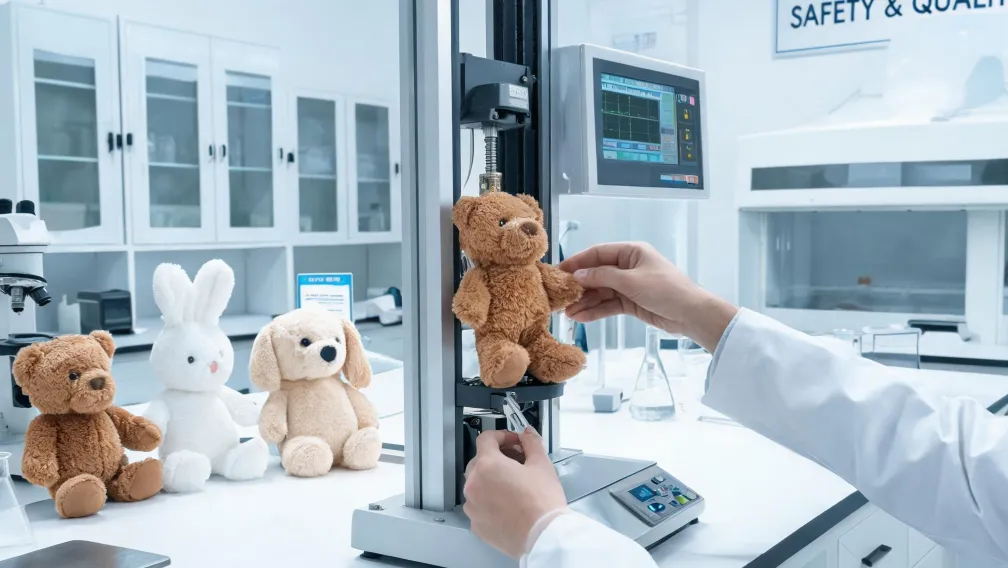
The quality risk that actually matters in bulk is not whether a factory can make one good sample — almost any can — but whether the 5,000th unit matches the one you approved. That consistency comes from process control: cutting every panel to the locked pattern, stuffing to a target weight, and inspecting each batch against the physical approved sample. A factory that keeps design, pattern-making, and production under one roof controls those steps directly, which is the real argument for a capable supplier regardless of country. Across a varied range — animals, dolls, keychains, mascots, bags — that integrated control is where China's experience shows, and it is why buyers comparing custom plush animals across suppliers should weigh demonstrated consistency, not just sample quality and unit price.
Lead Time and Shipping
This is the clearest US advantage. A Chinese production timeline typically runs 35 to 55 days from approved design to shipment — sampling, then bulk production — and then ocean freight adds roughly another 30 days to reach a US door. Air freight is faster but expensive enough that it is normally reserved for samples and urgent top-ups. Domestic US production, by contrast, ships in roughly 5 to 7 days once made, with no ocean transit and no customs clearance to wait on.
For a planned retail launch with a known on-shelf date, China's longer timeline is simply a scheduling input — you order earlier. For a last-minute event, a viral moment, or a reorder you need on a shelf in two weeks, that 30-day ocean gap is decisive, and domestic production is the only realistic route. Speed to market, not cost, is the factor that most often justifies paying a US premium.
The practical way to neutralize China's timeline is planning rather than expedited shipping. Lock the design and approve the sample early, place the bulk order with the full lead time built into your launch calendar, and the 35-to-55-day production window plus ocean transit becomes a non-issue. Where buyers get caught is the reorder: a product sells through faster than expected, and a fresh China run plus shipping cannot land before the shelf goes empty. The common strategy among established brands is to hold safety stock, time reorders well ahead of projected sell-through, and reserve a domestic maker for genuine emergencies. Air freight exists as a release valve, but it is expensive enough that it rarely makes sense for a full plush order — it is best kept for samples and small urgent top-ups rather than treated as a routine speed option.
Communication, IP, and Oversight
Three softer factors round out the picture. Communication across a 12-plus-hour time difference and a language gap is real, though an experienced export factory with English-speaking project managers narrows it considerably; same-country production removes it entirely. Intellectual property control is a common concern with overseas production — the mitigations are working with an established factory, using clear contracts, and registering your design — but domestic production keeps everything inside one legal system, which some brands with sensitive IP value highly. And physical oversight is easier at home: visiting a US factory is a short trip, while overseas oversight relies on video tours, photos, and third-party inspection. A factory that runs design and production under one roof and welcomes virtual or on-site visits closes most of that gap, but it is a gap that exists.
When US Domestic Actually Makes Sense
To be clear about the cases where domestic is the right call rather than the patriotic one: very small orders that fall below any overseas MOQ; turnaround measured in days rather than weeks; products where a verifiable "Made in USA" label carries real marketing weight with your customers; one-off prototypes or personal pieces; and programs with IP sensitive enough that keeping production in one jurisdiction is worth a premium. In each of these, the higher unit price buys something specific the buyer actually needs.
What does not usually hold up is choosing domestic purely on the assumption that it must be higher quality or that it dodges all the 2026 tariff noise. Quality depends on the individual factory, and even US makers often rely on imported plush fabrics and components, so "domestic" rarely means tariff-free all the way down. The decision is better made on volume, timeline, and branding than on a general preference.
How to Decide for Your Project
A simple way to read your own situation: if your order is in the hundreds-to-thousands range, your timeline allows for normal production and shipping, and your product needs a broad fabric or complexity range, a China plush factory will almost always give you the best combination of cost, capability, and consistency — even after tariffs. If your order is very small, your deadline is tight, or "Made in USA" is a selling point you can charge for, a US domestic maker earns its premium. Many established brands end up using both: China for the main retail line, a domestic maker for fast reorders or limited US-made editions.
If you are weighing a specific project, the most useful next step is a real quote against your actual spec — size, quantity, target market, and timeline — so you can compare total landed cost rather than headline rates. Send us your design or concept and we will lay out the numbers, the MOQ, and a realistic schedule so you can decide with the full picture. You can share your plush project to get that started.
FAQ
On unit price, China is consistently lower — industry executives have estimated US domestic production can run up to roughly three times the Chinese cost, mainly because plush is hand-sewn, labor-intensive work. The fuller comparison is landed cost: China's lower unit price plus about 17.5% US import duty (a 7.5% Section 301 tariff plus a 10% Section 122 surcharge as of 2026) and ocean freight, versus the US's higher unit price with no duty or international freight. For bulk orders, China usually still wins that math.
A Chinese factory generally works from around 300–1,000 pieces per design. US domestic factories sit in a similar bulk range (roughly 150–500), but the US is also home to low- and no-minimum custom services that will make anything from a single piece upward. Below roughly the low hundreds, a domestic small-batch service is often more practical; above it, a China factory wins on cost.
Quality tracks the individual factory, not the country — both produce excellent and poor plush. China offers far broader capability: a deep materials ecosystem and a large pool of skilled sewing operators that make complex pieces routine. US makers can excel in specific niches such as luxury artisan teddy bears but typically work from a narrower fabric library, with real limits on specialty fabrics.
Considerably faster on delivery. A Chinese timeline runs about 35–55 days from approved design to shipment, then roughly 30 more days of ocean freight to a US door. Domestic US production ships in about 5–7 days once made, with no ocean transit or customs clearance. For tight deadlines or fast reorders, that speed is the main reason to pay a US premium.
Not necessarily. Some 'Made in USA' plush is produced by importing unstuffed skins from China and finishing them domestically, labeled 'Made in USA with Imported Materials.' Even genuinely domestic makers often rely on imported plush fabrics and components, so 'domestic' rarely means tariff-free all the way down the supply chain.
Match the base to the order. For hundreds-to-thousands of units, a normal timeline, and a broad fabric or complexity range, a China factory usually gives the best mix of cost, capability, and consistency even after tariffs. For very small runs, tight deadlines, or a 'Made in USA' selling point you can charge for, a US domestic maker earns its premium. Many brands use both.