Quality Control for Custom Weighted Plush: A B2B Inspection and Compliance Guide
When a B2B buyer imports standard plush toys, quality control (QC) primarily focuses on visual symmetry, color accuracy, and embroidery alignment. However, when the product is a custom weighted plush toy containing 2 to 4 pounds of internal glass microbeads, the QC focus shifts from purely aesthetic checks to rigorous mechanical engineering verification. A single ruptured internal pouch transforms a therapeutic product into a severe choking hazard, resulting in immediate retail rejection and potential legal liability.
This guide provides procurement teams, brand managers, and third-party inspectors with a structured QC framework specific to weighted plush manufacturing. It details how to verify internal pouch integrity, test seam tensile strength, audit weight distribution (baffling), and execute the mandatory physical compliance checks required before authorizing a bulk shipment.
The Critical Role of the Pre-Production Sample (PPS)
How do you establish quality standards for a bulk weighted plush order?
Quality standards are established by signing off on a physical Pre-Production Sample (PPS), often called the "Golden Sample." For weighted plush, the buyer must verify not only the exterior design but also the internal mechanics. The buyer should request an "open" sample—a partially unsewn toy—to visually inspect the non-woven containment pouches, the quality of the glass or plastic beads, and the internal baffling structure. Once approved, this physical sample remains on the factory floor as the absolute baseline for all subsequent mass production inspections.
Without a physically approved PPS, third-party inspectors have no objective standard against which to measure the bulk output, leading to subjective disputes over "acceptable" firmness or weight distribution.
Inspecting Internal Containment: The Pouch System
The core liability in weighted plush manufacturing is bead leakage. The QC process must aggressively challenge the internal containment system.
Verifying Pouch Material and Seals
Inspectors must open a statistical sample of the finished production batch (destructive testing) to examine the internal pouches. The pouches must be constructed from high-density, tear-resistant non-woven fabric. Inspectors must verify the sealing method. Standard single-stitching is insufficient; the pouches must be sealed using double-overlock stitching or, preferably, ultrasonic welding, which melts the synthetic fibers together to create an impenetrable barrier against 0.8mm glass microbeads.
The Redundancy Check
For premium therapeutic lines, factories employ a double-pouch system (a sealed bag inside another sealed bag). Destructive testing must confirm the presence of both layers. If the outer plush shell is compromised during consumer use, this internal redundancy is the only safeguard preventing a hazardous leak.
Seam Tensile Strength and Drop Testing
The outer shell of a weighted toy absorbs massive kinetic energy during transport and daily use. Standard plush seams will fail under this kinetic load.
Tension Testing
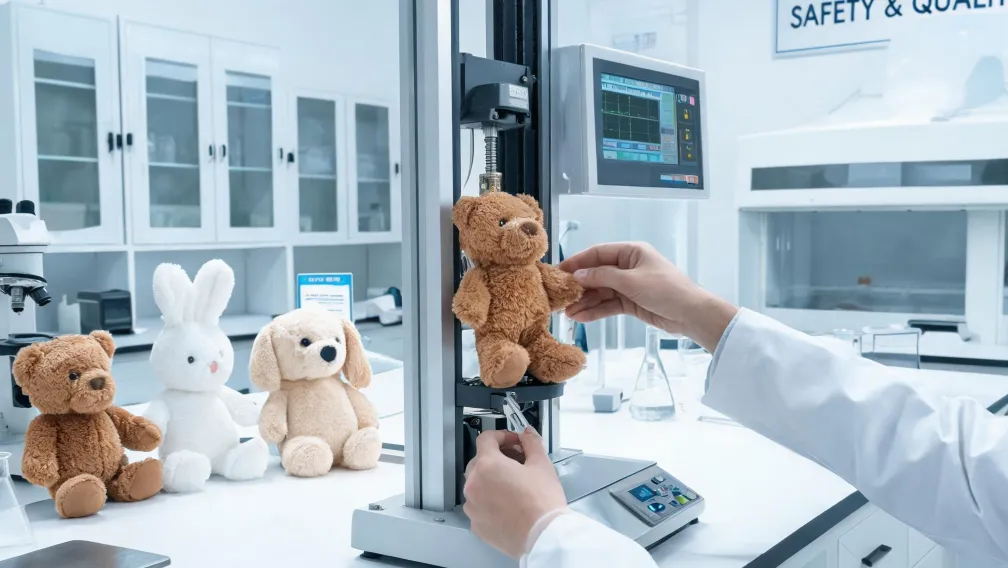
Inspectors use specialized force gauges to execute seam tension tests. The gauge hooks into the fabric on either side of a load-bearing seam (such as the neck or the attachment point of a weighted limb) and applies a sustained pull force—typically 70 Newtons (approx. 15.7 lbs) for 10 seconds, in accordance with ASTM F963 protocols. The seam must hold without exposing the internal stuffing or the bead pouches. Special attention must be paid to the final closure seam (the hand-sewn ladder stitch on the back or bottom of the toy), as this is the most common point of failure.
The Kinetic Drop Test
To simulate real-world abuse, the inspector performs a drop test. A 3-pound weighted toy is dropped from a height of 3 feet (approx. 0.9 meters) onto a hard concrete or vinyl-tiled surface. This is repeated multiple times, targeting different impact angles (head first, base first, side impact). Following the drops, the toy is thoroughly inspected for any signs of seam bursting, fabric tearing, or bead leakage. A failure here is an automatic batch rejection.
Weight Distribution and Baffling Verification
A weighted plush toy must feel balanced. If the factory fails to secure the internal pouches correctly, the heavy beads will migrate to one end of the toy over time, ruining the therapeutic deep-pressure effect.
During the QC inspection, the inspector performs a "shake test." The toy is held upside down and shaken vigorously for 30 seconds. The inspector then palpates (feels) the specific zones where the weight is supposed to be located (e.g., the paws or the lower abdomen). If the pouches have shifted significantly out of their designated zones, it indicates that the internal fabric baffles—the walls designed to lock the pouches in place—were either poorly sewn or omitted entirely to save labor time. This migration drastically reduces the product's lifespan and user satisfaction.
Fabric Density and Backing Validation
Heavy internal mass causes standard lightweight fabrics to stretch and sag. Weighted plush requires high-density textiles, typically 300 GSM or higher, often reinforced with a woven backing layer.
During destructive testing, the inspector must physically peel back the outer plush fabric (Velboa, Minky, or PV fleece) to verify the presence of the fused backing layer. If the factory substituted a cheaper, unbacked fabric to cut costs, the plush will permanently distort within a few weeks of retail purchase. Buyers can review appropriate high-tensile fabric options on our materials page.
Needle Detection and Final Safety Sweeps
Due to the thick, heavy-duty fabrics and bonded nylon threads used in weighted plush manufacturing, industrial sewing needles are highly prone to breaking during assembly. It is a strict regulatory requirement that no metal fragments remain inside the toy.
As the final QC gate before carton sealing, every single unit (100% of the batch, not a statistical sample) must pass through a calibrated industrial metal detector. Inspectors must verify that the machine is calibrated correctly using a test card containing a 1.2mm ferrous sphere. They must also review the factory's needle-logging ledger to ensure operators are actively tracking and replacing broken needles.
Structuring Your QC and Sourcing Plan
Importing weighted plush requires a proactive, highly technical quality control strategy. Relying on basic visual inspections will not expose the internal mechanical flaws that lead to product recalls.
When planning your next therapeutic merchandise line, ensure your manufacturing partner is equipped for double-pouching, high-tensile sewing, and rigorous kinetic drop testing. Review our specialized manufacturing capabilities in the weighted plush toys section. If you are converting an existing character IP into a weighted format, our engineering team manages the structural upgrades through our custom character plush workflow, providing transparent QC testing parameters before mass production begins.
FAQ
The inspector performs a destructive test on a statistical sample of the batch, cutting the toy open to verify the internal pouches. They check that the pouches are made of high-density non-woven fabric and are sealed using double-overlock stitching or ultrasonic welding to prevent glass microbeads from leaking.
Inspectors perform a kinetic drop test, dropping the weighted toy from a height of 3 feet onto a hard surface multiple times. The heavy mass exerts massive pressure on the seams upon impact. If a seam bursts or leaks beads, the toy fails compliance immediately due to the introduction of choking hazards.
Inspectors perform a "shake test," holding the toy upside down and shaking it vigorously. They then feel the specific zones where the weight should be (like the paws or base). If the weight has shifted, it means the factory failed to install the internal fabric baffles correctly.
Inspectors use specialized force gauges to pull on the load-bearing seams (e.g., the neck or limbs) with a sustained force of roughly 15.7 lbs (70 Newtons) for 10 seconds. The seam must not tear or expose the internal pouches, ensuring the toy meets ASTM F963 mechanical standards.
Due to the heavy-duty fabrics and bonded nylon threads used to secure the internal weight, sewing needles are highly prone to breaking during assembly. Every single toy must pass through a calibrated metal detector to ensure no broken needle fragments remain inside the stuffing.
No. Standard plush fabrics (around 150 GSM) will stretch, sag, and eventually tear under the constant pull of the internal weight. QC inspectors must verify that the factory used high-density fabrics (300 GSM+) that have been laminated with a secondary woven backing to prevent lateral stretching.