Custom Mascot Plush: A B2B Guide to Turning 2D Mascot Art into Production-Ready Plush
Custom mascot plush is a soft-toy product line built from the mascot of a brand, sports team, school, or event property, and its core difficulty is translation: a mascot exists as 2D artwork, while a plush toy is a 3D object that must sit, stand, and survive handling. The gap between a drawing and a production pattern is where most mascot projects succeed or fail. A front-view illustration carries no side or back information, exaggerated proportions fall over in physical form, and details that read well on screen disappear at merchandise sizes. This guide explains the 2D-to-3D conversion engineering behind custom mascot plush: turnaround sheets, simplification rules, input scenarios, size and price planning, color control, sampling pitfalls, and realistic timelines for brands, sports organizations, schools, and event marketing teams.
The Market Behind Mascot Merchandise
Grand View Research values the global licensed sports merchandise market at approximately $38 billion in 2025, with a projection of $59.4 billion by 2033 at a compound annual growth rate of 5.9 percent. Within that market, toys and games form the largest product segment at 29.9 percent of revenue. The US collegiate channel adds an estimated $4.6 billion in annual retail sales of licensed merchandise, based on CLC figures. For brands, teams, and schools, the mascot is frequently the most merchandisable asset in the identity system: it carries no roster turnover, no season dependency, and strong recognition among children and families. The commercial return on that asset depends on how faithfully the plush version reproduces the character, because a mascot plush that reads as a generic animal at arm's length sells like a generic animal.
Why 2D Mascot Art Cannot Go Straight to Production
The sections below follow the conversion workflow used in custom mascot plush production, from artwork intake to bulk approval.
The Front View Problem
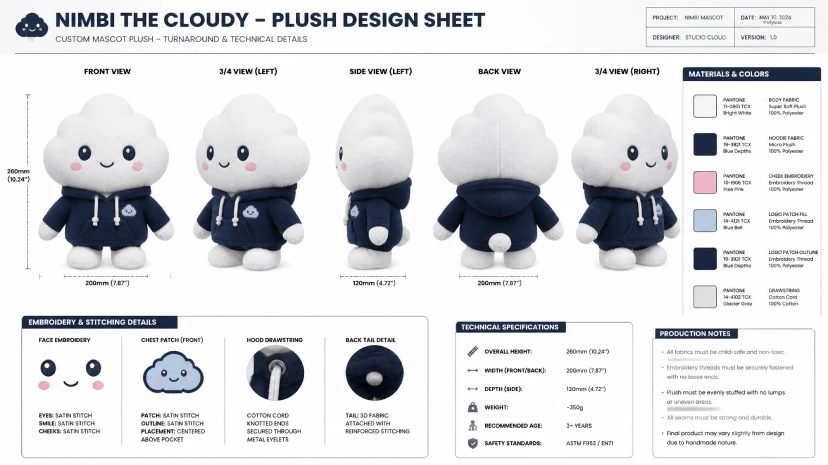
A mascot illustration is almost always a front view, and a front view carries no information about the side profile or the back. A plush pattern maker must still cut panels for both. When the only reference is a single front image, the pattern maker has to invent the shape of the back of the head, the depth of the body, and the tail placement. If that guess is wrong, the error surfaces only in the physical sample, and correcting it costs a full additional sampling round. A complete turnaround sheet, showing front, back, side, and three-quarter views, removes the guesswork before any fabric is cut.
Proportions That Survive Gravity
Mascot designs are drawn for visual impact, which usually means a large head on a small body. Built literally, such a plush is top-heavy: it tips forward, cannot sit unaided, and reads as defective on a retail shelf. Pattern makers resolve this by adjusting proportions, adding weight low in the body, or widening the base, while keeping the face and silhouette intact. Hand-drawn asymmetry creates a related problem. A tilted ear or an uneven smile looks charming in a sketch; mirrored into a symmetrical 3D pattern it becomes an obvious defect, so asymmetric marks are either regularized or specified as deliberate printed details. Poses drawn in perspective or foreshortening cannot be built at all, because no fabric panel can reproduce a shortened limb.
Recognition at Merchandise Scale
The silhouette is the first recognition element of any mascot product. Buyers and fans identify the character by outline before they register color or face, so the pattern must preserve the outline above all other features. Inside the silhouette, facial geometry carries the expression: eye spacing, the angle of the mouth corners, and brow shape all require millimeter-level precision, because a two-millimeter shift in eye placement changes the character's mood. Scale compounds the problem. A design drawn for a 35-centimeter toy that is reduced to 15 centimeters needs enlarged facial features and thicker lines, since embroidery and printing have minimum element sizes below which detail dissolves.
The Turnaround Sheet: What the Pattern Maker Needs
A production-ready turnaround sheet shows the character from four angles on one page: front, back, side, and three-quarter view, drawn to the same height and aligned. From this single document a pattern maker can derive every panel. The sheet should also carry Pantone references per color zone, mark which elements are embroidery versus print, and state a target height. Clients without in-house design capacity can commission the turnaround from the illustrator who drew the original mascot; file formats and preparation steps are covered in our guide to preparing artwork for plush production. The turnaround stage is the cheapest point in the project to fix design problems, because corrections cost minutes of drawing time instead of a sampling round.
Simplification Decisions: From Artwork to Plush Construction
Almost every mascot design requires simplification before it can be sewn, and the decisions follow stable rules. Making them on paper during the turnaround stage costs nothing; discovering them in a physical sample costs a round. The table below lists the standard conversions pattern makers apply.
| Artwork Feature | Problem in Plush | Standard Conversion |
|---|---|---|
| Fine outlines and thin strokes | Below minimum sewing and embroidery size | Convert to embroidery lines |
| Gradients and soft shading | Plush fabric holds flat color only | Solid color blocks or heat sublimation print |
| Thin arms, legs, or antennae | Cannot be stuffed or hold their shape | Widen to a sewable, stuffable diameter |
| Asymmetric details | Read as defects in a mirrored 3D form | Symmetrize, or apply as deliberate print |
| Dense facial detail at small sizes | Dissolves below embroidery minimums | Enlarge features and thicken lines |
These conversions change the drawing, and that is expected. A plush toy is a different medium from a logo file, and a faithful plush preserves recognition before detail. Approving the simplified artwork in writing before sampling begins prevents the most common dispute in mascot projects: a client comparing the sample against the original illustration instead of against the approved production artwork.
Three Input Scenarios: Turnarounds, Single Images, and Costume Photos
Full Turnaround Sheets
Complete views, Pantone callouts, and logo files are the fastest and cheapest starting point. Sampling can begin directly, and the first sample usually lands close to final.
A Single Illustration or AI-Generated Image
Most clients arrive with one image. In this scenario the pattern team drafts the missing side, back, and three-quarter views and returns them for written approval before cutting, which typically adds one to two weeks. AI-generated mascot images follow the same path, with one additional caution: generated images often contain physically impossible construction, such as fur that changes direction mid-limb, accessories that float free of the body, or shading with no fabric equivalent. These elements are resolved during the simplification pass described above.
Only a Mascot Costume or Event Photos
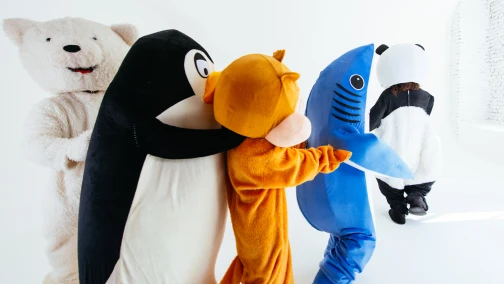
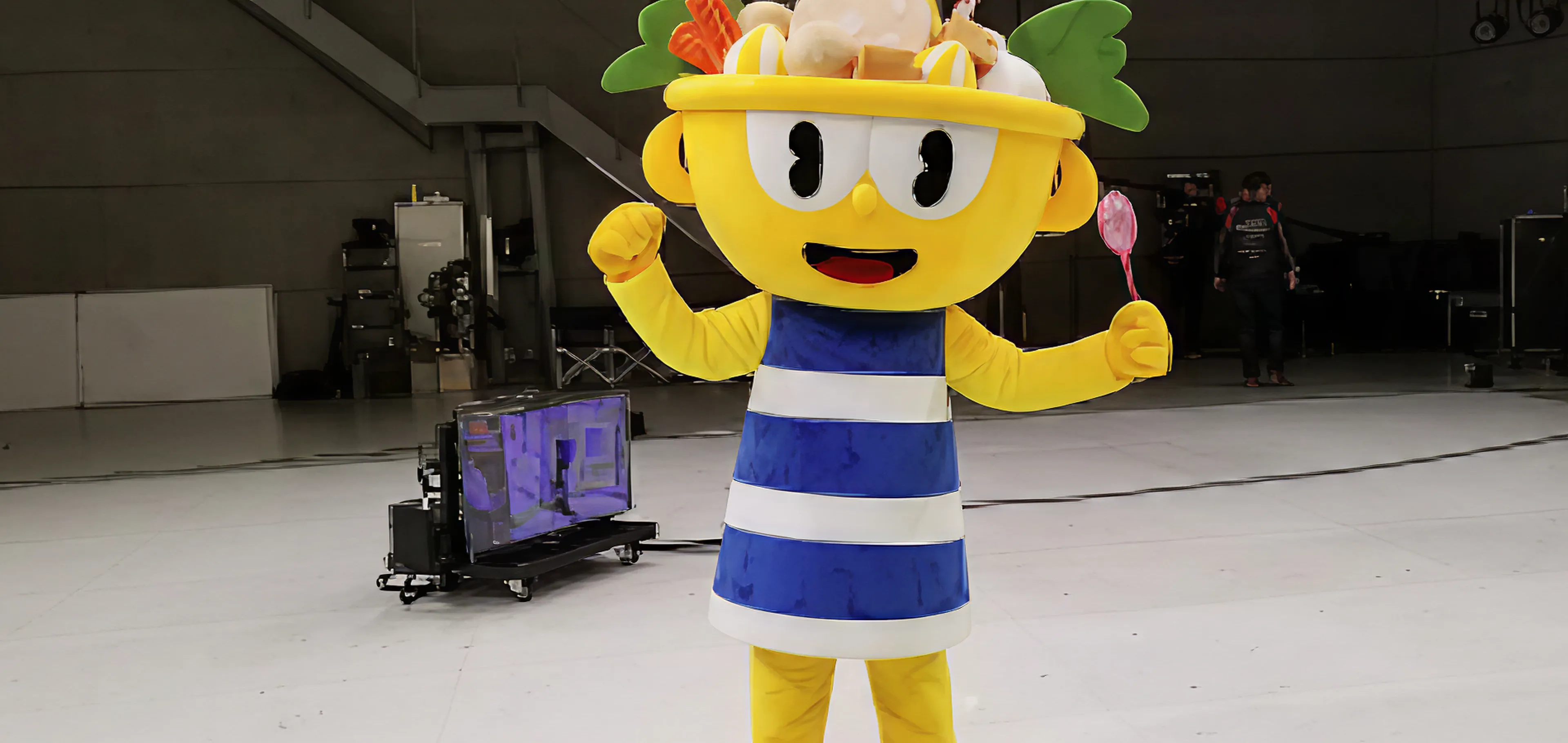
The third scenario is common among sports teams and event agencies: the mascot exists only as a worn costume. The reference package then consists of front, side, and back photographs of the costume, Pantone values, and original logo files. The correct method here is character element extraction rather than proportional shrinking. A costume is built around a human body, with human shoulder widths and sight-line compromises, so shrinking it directly produces an unreadable toy. Instead, the design team extracts the recognition elements, such as head shape, eye style, color layout, and signature accessories, and rebuilds them onto plush-appropriate proportions. Photograph the costume on a plain background in even daylight for usable reference.
Size, Use Case, and Price Planning
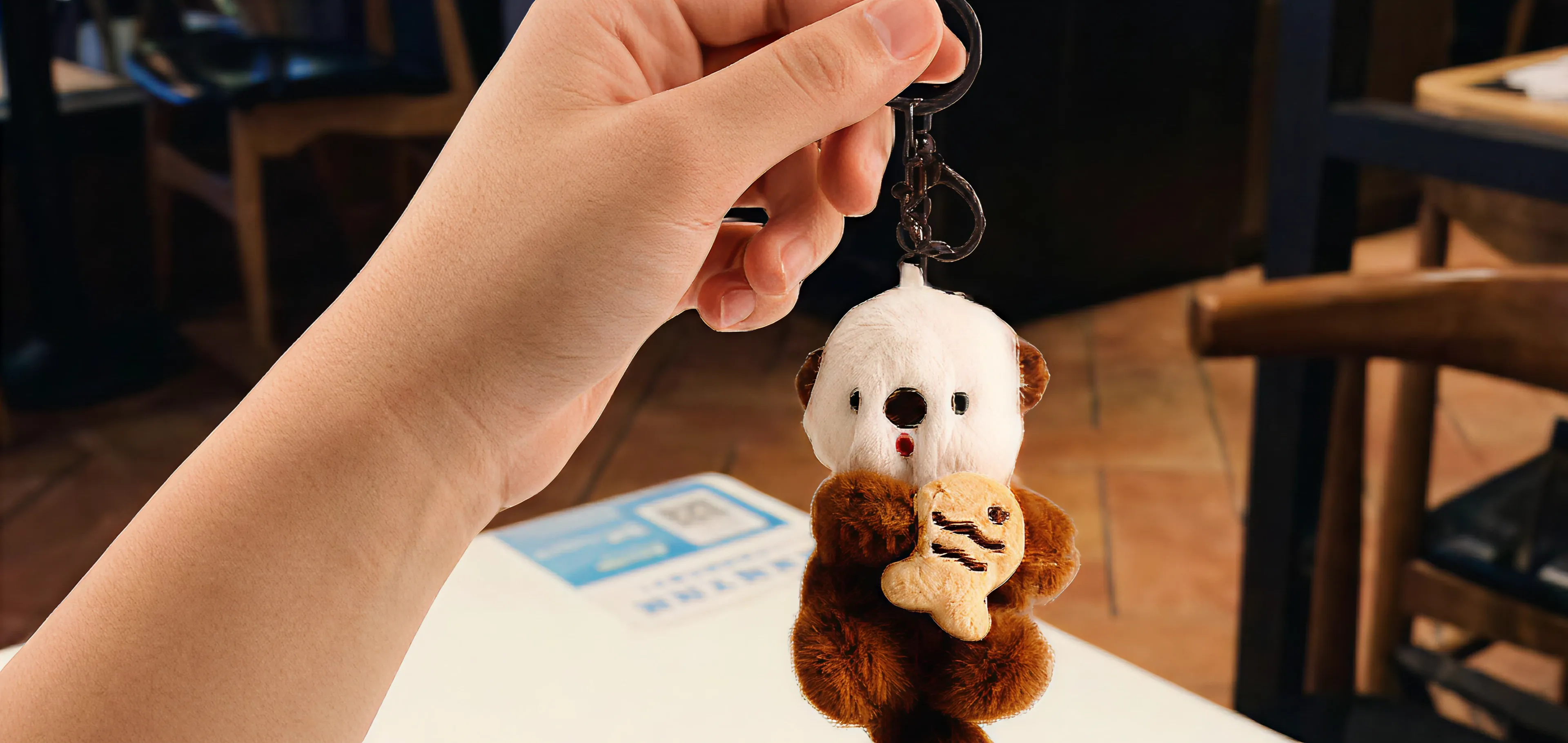
Size is a commercial decision before it is a design one, and each use case has an established band. Giveaway and event handout mascots typically run 15 centimeters. Retail mascot plush sits at 20 to 30 centimeters, the band where perceived value supports a standard retail price. Mascot keychains and bag charms run 8 to 10 centimeters and extend the character into a lower price point; construction details for that format appear on the custom plush keychains page. Display and photo-op pieces start at 40 centimeters. The table below consolidates the cost and retail bands buyers work with.
| Class | Typical Size | Unit Cost | Common Retail Band |
|---|---|---|---|
| Keychain | 3-4 in (8-10 cm) | $1.50-2.50 | $5.99-9.99 |
| Standard | 8-12 in (20-30 cm) | $3.50-6.00 | $14.99-24.99 |
| Large | 16-24 in (40-60 cm) | $8-14 | $34.99-69.99 |
| Giant | 28-40 in (70-100 cm) | $25-45 | $89.99-199.99 |
Costs assume standard short-pile fabric, embroidered facial features, and quantities inside normal MOQ ranges; licensed characters and complex construction move pricing upward. SKU planning follows the channel. A team store can support four to six mascot SKUs across sizes and poses. A college bookstore typically carries two to three. A corporate program usually needs one or two. The practical sequence is to fix the channel, set the retail band, choose the size that supports it, and only then commission production artwork, because size determines which details survive.
Mascot Plush vs. Mascot Costume: Two Product Lines, One Character
These two product lines serve the same character but answer different briefs. Mascot plush is batch merchandise: minimum orders in the hundreds of pieces, unit costs between $2 and $14, made for retail shelves and giveaway volume. A mascot costume is a live-interaction asset: a single handmade piece at roughly $150 to $400, worn by a performer at games and events. Many organizations commission both, and developing them from one shared character package keeps the toy on the shelf visually consistent with the character on the field. That shared package is the turnaround sheet, Pantone set, and logo files described earlier. Costume construction follows a different workflow, covered on the custom mascot costumes page.
Color Accuracy and Brand Fidelity Control
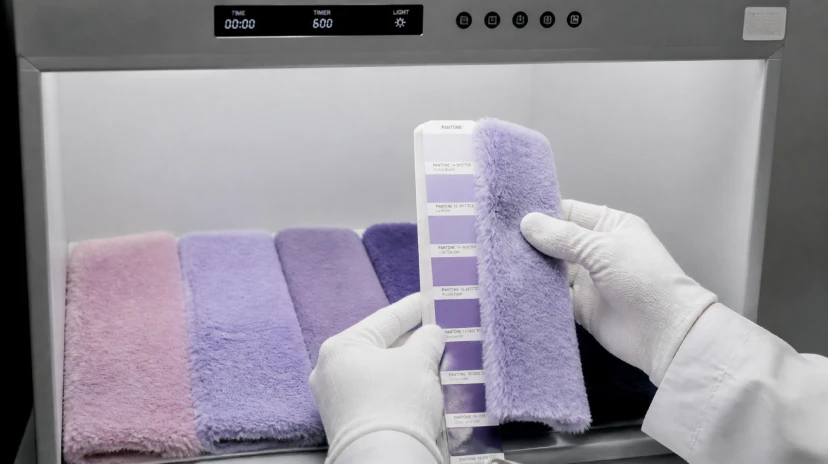
Brand teams often treat a Pantone number as a guarantee. On plush it is a starting direction, for physical reasons: fabric pile has a direction and a height that change how the same dye reads, dye lots vary between batches, and colors shift under different lighting. The control process is sequential. Lock the Pantone references, produce a lab dip on the actual fabric, approve the lab dip under a D65 standard light source, lock the bulk dye lot against the approved dip, check incoming fabric against the lot standard, and record the agreed tolerance in writing.
Order size shapes the method. Below roughly 2,000 pieces, projects normally use near-color stock fabric, because custom dyeing carries its own high minimums; the supplier matches the closest stock shade and the written tolerance defines what close means. Above that volume, dyeing to the Pantone reference becomes practical. One physical detail catches many buyers off guard: pile density interacts with embroidery. If pile density drops below specification, facial embroidery sinks into the pile and the expression changes, so pile density belongs in the written fabric specification alongside the color reference.
Licensed and brand programs therefore run quality control on two tracks. The first is the standard toy safety inspection. The second is brand fidelity: Pantone checks under D65 light, logo placement within an agreed positional tolerance, and a photographed archive of approved samples that anchors future reorders.
Sampling, Timeline, and the Mistakes That Add Rounds
The production side of a mascot plush project is measured in weeks: sampling takes 10 to 20 days and bulk production 22 to 35 days. The full project, including design conversion and licensing approval, runs 14 to 20 weeks. Minimum order quantities vary by factory, commonly 100 to 1,500 pieces per design; our standard MOQ is 300 to 500 pieces. Two to three sample revision rounds is a normal rhythm, and planning for them is what keeps the calendar honest. Most sampling failures trace back to eight preventable decisions.
- Reviewing samples from front photos only: side and back errors go unseen until bulk production.
- Preserving too much detail: elements below embroidery minimums read as defects at scale.
- Rushing the turnaround stage: an error locked into the pattern is the most expensive kind to fix.
- Approving color from small swatches: large sewn areas shift visibly against a swatch, so approve a sewn panel or the sample itself.
- Sampling before the size is fixed: a size change restarts the pattern work.
- Leaving stuffing density undefined: the approved sample's shape cannot be reproduced in bulk without a fill-weight specification.
- Staying undecided on embroidery versus print: each switch resets the face approval.
- Treating revisions as failures: two to three rounds is the planned path, and compressing them usually means approving a sample that is not right.
Two adjacent topics sit outside this guide. Licensing approval workflow and timing are covered in the custom plush for brand and IP licensing guide, and standard toy safety requirements apply to mascot plush as they do to any children's product.
Maris Plush has manufactured custom plush for 18 years for brands, sports organizations, schools, IP owners, and event marketing agencies. To price a mascot project, send your artwork or reference photos, target size, quantity, and destination market through the contact page, and the team will return a quotation with a sampling schedule.
FAQ
Unit cost depends on size, materials, construction complexity, and quantity. Working bands: keychain mascots of 3 to 4 inches (8 to 10 centimeters) run $1.50 to $2.50 per piece, standard 8 to 12 inch mascots run $3.50 to $6.00, large 16 to 24 inch versions run $8 to $14, and giant 28 to 40 inch display pieces run $25 to $45. Design conversion and sampling are quoted separately, and licensed characters add royalty costs.
Minimum order quantities vary by factory, commonly 100 to 1,500 pieces per design. Our standard MOQ is 300 to 500 pieces per design. Custom-dyed fabric raises the effective minimum because dye houses carry their own minimums, so orders below roughly 2,000 pieces typically use near-color stock fabric.
Plan for 14 to 20 weeks for the full project when licensing approval is involved. The production portion is shorter: sampling takes 10 to 20 days and bulk production 22 to 35 days. Two to three sample revision rounds is the normal rhythm, so schedule backward from your selling season or event date rather than from the order date.
Yes. Provide front, side, and back photographs of the costume or character, Pantone color values, and original logo files. The design team extracts the recognition elements, such as head shape, eye style, color layout, and signature accessories, and rebuilds them onto plush-appropriate proportions. A costume is built around a human body and cannot simply be scaled down into a toy.
Pantone references are the starting point, because pile direction, pile height, dye lots, and lighting all change how a color reads on fabric. The standard process locks the Pantone set, produces a lab dip on the actual fabric, approves it under D65 standard lighting, locks the bulk dye lot, checks incoming fabric against the standard, and records a written tolerance. Orders under about 2,000 pieces usually match the closest stock fabric shade instead of commissioning a custom dye run.
Match the size to the use case and retail band. Giveaways work at 15 centimeters, retail mascot plush at 20 to 30 centimeters, keychains at 8 to 10 centimeters, and display pieces at 40 centimeters and above. A team store can support four to six SKUs, a college bookstore two to three, and a corporate program one or two. Fix the size before sampling begins, since a size change restarts the pattern.
A mascot plush is batch merchandise: hundreds of pieces per order at $2 to $14 per unit, made for retail shelves and giveaways. A mascot costume is a live-interaction asset: a single handmade piece at roughly $150 to $400, worn by a performer at games and events. Many organizations commission both from one shared character package so the merchandise and the live character stay visually consistent.