Custom Plush Toy Packaging, Vacuum Compression, and B2B Freight Guide
Packaging and freight frequently account for 20% to 40% of the landed cost of a bulk plush toy order. Because soft toys have high cubic volume relative to their physical weight, ocean and air carriers bill shipments by volumetric weight (CBM) rather than gross tonnage. A factory quote with an attractive FOB unit price can produce an uncompetitive landed cost if carton engineering, vacuum compression ratios, and retail packaging logistics are left unspecified until the end of production.
This guide examines the engineering and logistics parameters of custom plush toy packaging and international freight: polybag and retail box specifications, industrial vacuum compression limits, 72-hour recovery testing, mandatory labeling rules, carton loading optimization, and trade term selection. It is written for procurement teams, brand managers, and supply chain planners managing bulk plush imports.
Why Packaging Must Be Engineered Before Bulk Production
Packaging decisions affect upstream pattern engineering, unit pricing, and container utilization. Specifying a rigid window box after bulk sewing begins creates immediate bottlenecks: the toy's seated height or ear span may exceed the standard die-cut box cavity, forcing either a costly custom tooling change or a compressed display posture that damages retail presentation.
Confirming the packaging bill of materials (BOM) alongside the pre-production sample locks three variables early:
- Unit cost accuracy: Retail boxes, belly bands, hangtags, and custom polybags add $0.15 to $1.20 per piece depending on board weight and print finish.
- Container load planning: Master carton dimensions determine how many units fit into a 20GP, 40GP, or 40HQ container, directly setting the freight cost per piece.
- Compliance readiness: Warning labels, country-of-origin markings, and tracking codes are printed directly on polybags, hangtags, or sewn-in tush tags before final packing.
Primary Packaging Formats for B2B Plush Orders
What are the standard packaging options for wholesale custom plush toys?
Wholesale custom plush toys ship in four primary formats: individual OPP or PE polybags for e-commerce and bulk wholesale, multi-piece master polybags for arcade and promotional distribution, flat-packed retail window or gift boxes for brick-and-mortar shelves, and corrugated PDQ display trays for supermarket and big-box retail programs.
Individual Polybags (OPP vs. LDPE)
Individual polybags remain the baseline protection against humidity, dust, and carton abrasion during ocean transit. Oriented Polypropylene (OPP) bags offer high optical clarity and crisp presentation for retail fulfillment, though their seams split more easily under vacuum pressure. Low-Density Polyethylene (LDPE) or PA/PE co-extruded bags provide higher puncture resistance and heat-seal integrity, making them the standard choice for vacuum-compressed shipments.
For US and EU distribution, any flexible polybag with an opening of 5 inches (12.7 cm) or larger and a film thickness under 1.5 mil (0.038 mm) requires a printed suffocation warning in specified font sizes, along with punched ventilation holes on retail-bound bags.
Retail Window Boxes, Header Cards, and PDQ Trays
Brick-and-mortar retail programs rely on structural paperboard packaging to hold shelf positioning and protect light-colored fabrics from shopper handling. Standard window boxes use 350 to 400 GSM single-coated white card (C1S) or E-flute corrugated board laminated with a printed sheet and a PET transparent window. For heavy items such as weighted plush toys, standard hangtags and plastic swift-tacks tear under load; reinforced corrugated mailer boxes or floor-standing PDQ trays are required to support the physical mass.
| Packaging Format | Typical Material Spec | Vacuum Compatible | Best Commercial Channel |
|---|---|---|---|
| Individual LDPE / PA-PE bag | 0.05–0.08 mm co-extruded film | Yes (individual or bulk) | Amazon FBA, DTC e-commerce, wholesale |
| Master polybag (bulk) | 0.06–0.08 mm heavy PE liner | Yes (multi-piece compression) | Claw machines, events, promotional giveaways |
| Retail window / gift box | 350–400 GSM C1S or E-flute + PET | Flat-packed separately only | Specialty retail, museum shops, IP licensing |
| Corrugated PDQ tray | B-flute or E-flute kraft board | Plush compressed, tray flat | Supermarkets, big-box retail chains |
| Polyester drawstring dust bag | 190T polyester or cotton canvas | Partial compression | Luxury retail, collectible editions |
Industrial Vacuum Compression: Mechanics and Engineering Limits
How much does vacuum packing reduce plush toy shipping volume?
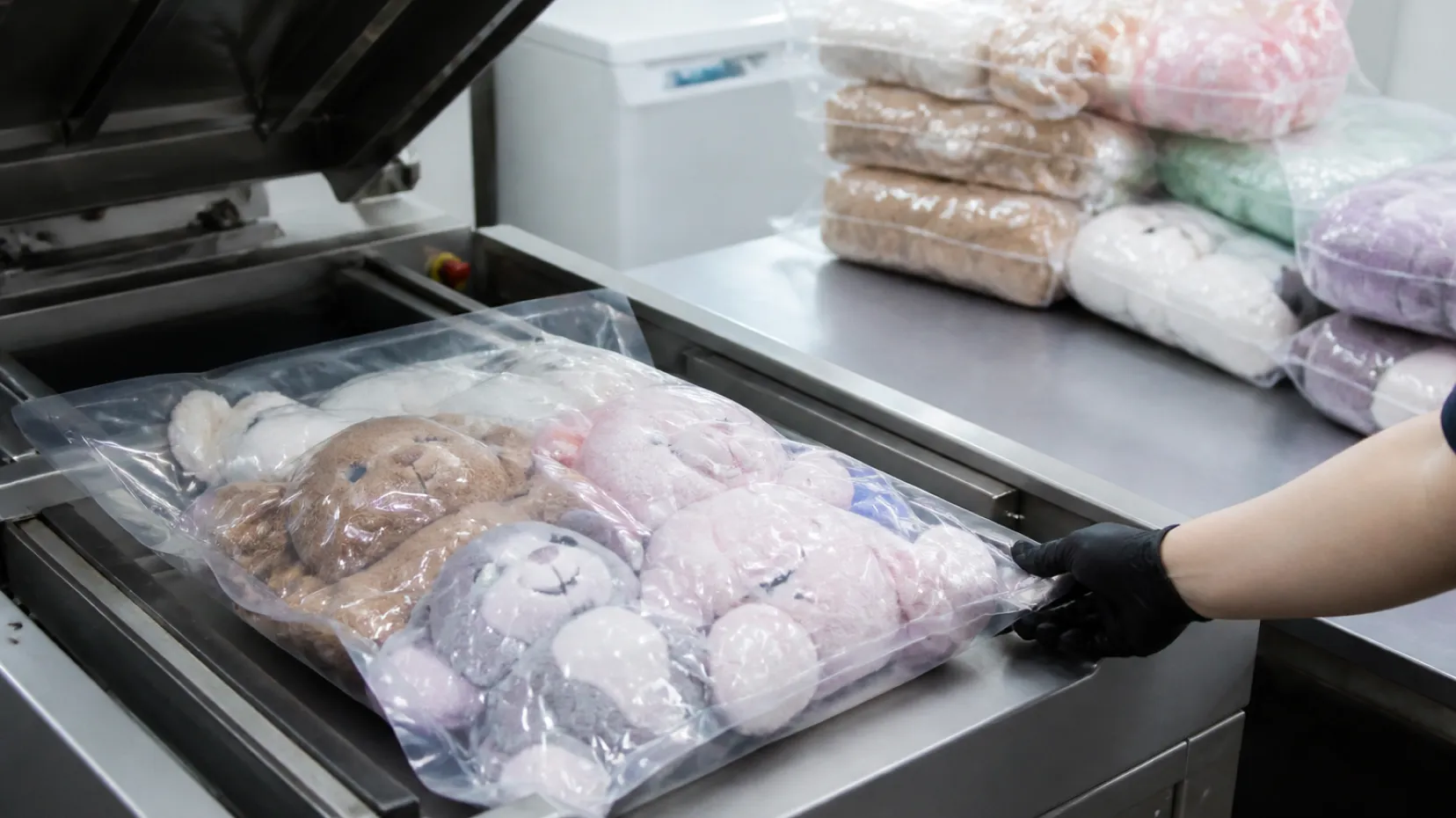
Industrial vacuum compression reduces carton volume by 50% to 70% for standard PP-cotton filled plush toys. A 1,000-piece order of 25 cm plush animals that requires 14 to 16 CBM in loose cartons typically compresses to 5 to 7 CBM, cutting ocean freight expenditure by roughly half.
Controlled Compression Ratios (60%–65% vs. Over-Compression)
Maximum vacuum extraction is rarely optimal. Pulling a chamber sealer to 90% volume reduction creates rigid, brick-like blocks that place severe bending stress on embroidered facial panels, plastic safety eyes, and seam allowances. During a 30-to-40-day ocean voyage under container stacking loads, over-compressed plush develops permanent fold lines across short-pile fabrics like crystal super soft or Velboa.
Factory best practice targets a controlled 60% to 65% volume reduction. This level captures the majority of volumetric freight savings while preserving enough microscopic air space inside hollow siliconized polyester fibers to allow clean rebound upon opening. This parameter is particularly critical for high-volume items such as custom plush pillows and giant plush toys, where loft recovery defines perceived quality.
Plush Structures Unsuitable for Vacuum Compression
Before authorizing vacuum sealing, pattern engineers screen the bill of materials for rigid or heat-sensitive components. Vacuum compression should be avoided or limited to light air-evacuation for designs containing:
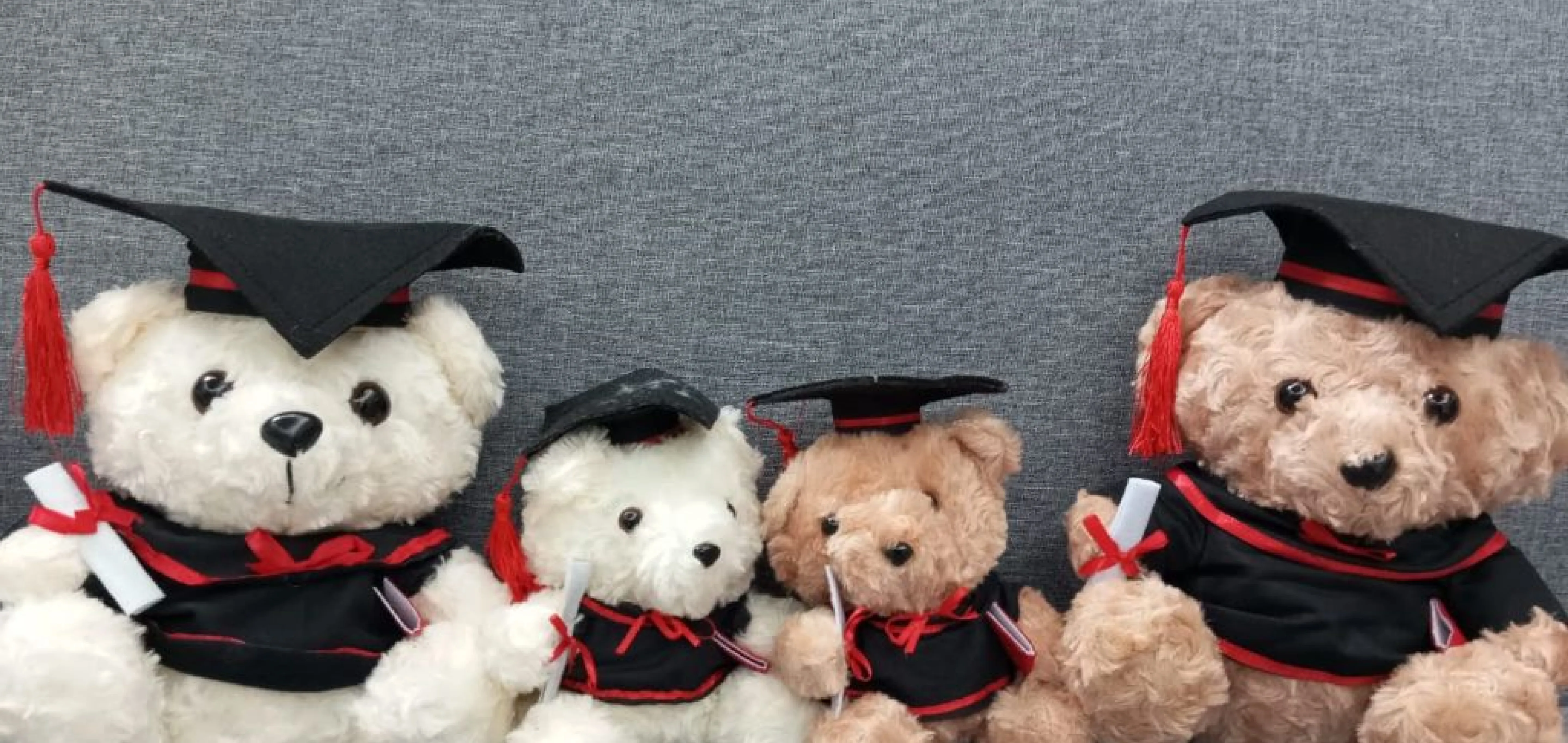
- Internal EVA foam or cardboard stiffeners: Standing dolls, graduation mortarboards, and structured custom plush bags develop irreversible creases across foam plates under vacuum pressure.
- Electronic sound or LED modules: External atmospheric pressure presses battery housings against outer fabrics, risking switch activation, battery drain, or fabric marking.
- Hard plastic accessories and oversized safety eyes: Rigid components pressed against opposite fabric panels leave permanent indentation rings in minky and velboa pile.
- Pre-assembled retail boxes: Toys already seated inside cardboard display boxes cannot be compressed; the standard workaround is vacuum-sealing the plush in bulk cartons and shipping the die-cut boxes flat in separate cartons for local kitting.
72-Hour Compression and Shape Recovery Testing
Vacuum packaging performance depends directly on internal fill quality. Virgin 3D hollow conjugated siliconized PP cotton recovers loft reliably because the helical fiber crimp acts as a microscopic spring. Low-grade recycled or non-siliconized fibers clump under sustained pressure and heat. Full fiber specifications are detailed on our materials page.
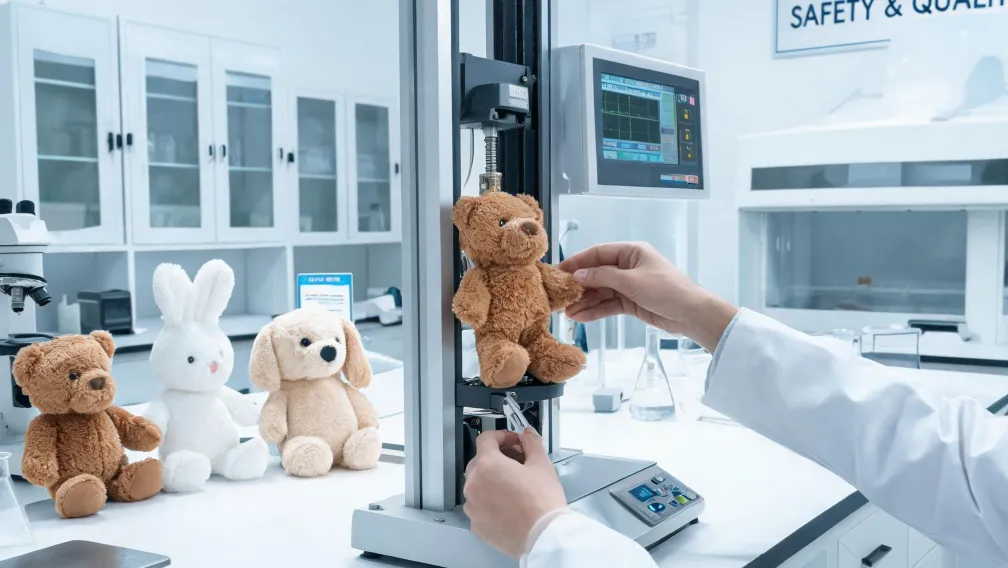
Prior to bulk packing on a new SKU, procurement teams should require a 72-hour accelerated recovery test on three pre-production units:
- Orientation and sealing: Fold limbs inward without creasing embroidered eyes or faces, then seal inside a 0.08 mm PA/PE bag at the target 60% to 65% compression ratio.
- Container heat and load simulation: Place the sealed units under a 15 kg static weight at 35°C to 40°C for 72 hours to replicate summer ocean container stacking conditions.
- Seal integrity audit: Inspect bags after 72 hours for premature air leakage ("leakers"), which cause cartons to bulge and burst during transit.
- Rebound measurement: Open the bag, manually knead the torso for 30 seconds to introduce air, and measure volume recovery at 15 minutes and 24 hours. Passing units regain at least 95% of baseline height and width within 24 to 48 hours with no permanent seam distortion.
Mandatory Labeling, Tags, and Regulatory Markings
Packaging and labeling errors trigger more customs holds than physical toy defects. Even when the plush toy passes laboratory testing, missing or improperly formatted markings can block entry at US or European ports. Required documentation and testing frameworks are outlined on our safety and compliance page.
- Sewn-in tush tag (permanent): Must list fiber content (e.g., "All New Material: Polyester Fiber"), care instructions, country of origin ("Made in China"), and—for US children's products—a CPSIA tracking code showing manufacturer identity, production date, and batch number.
- State law labels (US): Plush pillows, cushions, and certain stuffed articles sold in states such as Pennsylvania, Ohio, and Massachusetts require a registered law label specifying filling weight percentages and a Uniform Registry Number (URN).
- EU CE / UKCA and Authorized Representative markings: Must appear permanently on the toy or its packaging alongside the physical address of the EU or UK importer/responsible person.
- Retail barcodes and carton shipping marks: EAN-13 or UPC-A barcodes go on hangtags or polybag stickers, while master cartons require standardized shipping marks listing PO number, SKU, quantity per carton, gross/net weight, and carton dimensions.
Master Carton Engineering and Container Load Planning
Master carton specification protects compressed goods from humidity and forklift handling while maximizing container cube utilization. Standard export cartons for plush toys use 5-ply double-wall corrugated board (K=K or A=B grade) with a burst strength rated for multi-tier container stacking. Moisture-absorbing silica gel or calcium chloride desiccant pouches are placed inside outer cartons during humid summer shipping seasons to prevent mildew on long ocean transits.
Carton dimensions must balance container geometry with warehouse ergonomics. For Amazon FBA shipments, no individual carton side may exceed 25 inches (63.5 cm) unless the single unit itself is oversized, and gross carton weight must remain under 50 lbs (22.7 kg). For standard retail warehouse deliveries, cartons sized around 60 x 45 x 45 cm (0.1215 CBM) or 63 x 45 x 58 cm (0.164 CBM) stack cleanly inside a 40HQ container (68 CBM usable capacity) with minimal dead space.
| Shipment Profile (25 cm Plush, 1,000 Units) | Packing Method | Approx. Cartons | Total Volume (CBM) | Freight Impact |
|---|---|---|---|---|
| Loose individual polybags | Uncompressed | 18–20 cartons | 14.0–16.0 CBM | Baseline LCL ocean cost |
| Vacuum-compressed polybags | 60%–65% compression | 7–9 cartons | 5.5–7.0 CBM | 50%–60% lower ocean freight |
| Pre-assembled retail window boxes | Uncompressed in display boxes | 25–30 cartons | 20.0–24.0 CBM | 40%–50% higher than loose |
| Split shipment (compressed + flat boxes) | Plush vacuumed, boxes flat-packed | 9–11 cartons | 6.5–8.0 CBM | Requires local kitting labor |
International Freight Modes and Incoterms (FOB vs. DDP)
Should B2B buyers ship custom plush toys by sea or air?
Sea freight is the standard mode for bulk plush orders because air freight bills at a 1:6000 volumetric divisor (cm³/6000 = kg), making air shipping 4 to 6 times more expensive than ocean freight. Air cargo is reserved for pre-production samples, urgent event launch batches, or small-format runs like mini plush toys when seasonal deadlines override freight margins.
Transit times from major Chinese ports (Shanghai, Ningbo, Shenzhen) to US West Coast ports run 18 to 25 days port-to-port, and 30 to 40 days to US East Coast or European ports, excluding customs clearance and inland trucking. Rail freight to Europe offers an intermediate 22-to-30-day window at roughly twice the cost of ocean shipping.
Selecting the right Incoterm depends on internal logistics capability:
- FOB (Free on Board): The factory delivers cleared goods to the designated export port. Best for established importers with contracted freight forwarders and customs brokers who want full visibility into ocean rates and duty filings.
- CIF (Cost, Insurance, and Freight): The supplier arranges ocean transport and basic marine insurance to the destination port, while the buyer handles import customs clearance, port charges, and inland delivery.
- DDP (Delivered Duty Paid): The supplier manages export clearance, ocean or air freight, import duties, and final truck delivery to the buyer's warehouse or FBA fulfillment center. DDP simplifies landed-cost budgeting for newer brands and promotional agencies, though buyers should verify that the supplier provides proper customs entry records for compliance auditing.
To evaluate how packaging and freight interact with unit production pricing, review our custom plush toy cost breakdown.
Planning Packaging and Freight for Your Next Plush Order
Maris engineers packaging, vacuum compression protocols, and export logistics alongside pattern development so carton dimensions, compression recovery, and compliance labels are verified before bulk cutting begins. Send your target dimensions, retail channel requirements, and destination port through our contact page to receive a complete quotation covering unit production, packaging BOM, and estimated CBM within 48 hours.
FAQ
Industrial vacuum compression reduces total shipment volume by 50% to 70% for standard PP-cotton filled plush. Because ocean LCL and air carriers bill by cubic volume (CBM), compressing a 1,000-piece order of 25 cm plush toys typically cuts international freight costs by roughly half.
No, provided the factory uses high-resilience hollow siliconized PP cotton and limits compression to 60% to 65% of original volume. Once the vacuum bag is opened and the toy is kneaded to introduce air, passing units recover at least 95% of their original shape within 24 to 48 hours.
Plush toys containing rigid internal EVA foam plates, cardboard stiffeners, electronic sound or LED modules, oversized hard plastic accessories, or pre-assembled retail boxes should not be heavily vacuum compressed. Vacuum pressure causes permanent creasing in foam inserts and indentation marks around hard parts.
For most volume programs, shipping plush toys vacuum-compressed in bulk cartons while flat-packing the die-cut retail boxes separately cuts ocean freight volume by 60% or more. Pre-assembling at the factory is only economical when destination labor costs exceed the additional sea freight expense.
US and EU imports require a permanent sewn-in tush tag listing fiber content, care instructions, and country of origin. US children's products also require a CPSIA tracking label, while EU shipments require CE markings and an EU Responsible Person address. Polybags with openings of 5 inches or wider and film under 1.5 mil require printed suffocation warnings.
Under FOB terms, the factory delivers goods to the Chinese export port and the buyer's freight forwarder handles ocean shipping, customs clearance, and import duties. Under DDP terms, the supplier manages the entire chain—including freight, tariffs, and final delivery to your warehouse—giving you a single all-in landed cost.
Port-to-port ocean transit from Shanghai or Ningbo typically takes 18 to 25 days to US West Coast ports and 30 to 40 days to US East Coast or European ports. Adding customs clearance, container devanning, and domestic trucking brings door-to-door timelines to 30 to 50 days.