Claw Machine Plush Toys: A B2B Sourcing Guide to Winnable Design, Payout Economics, and Compliance
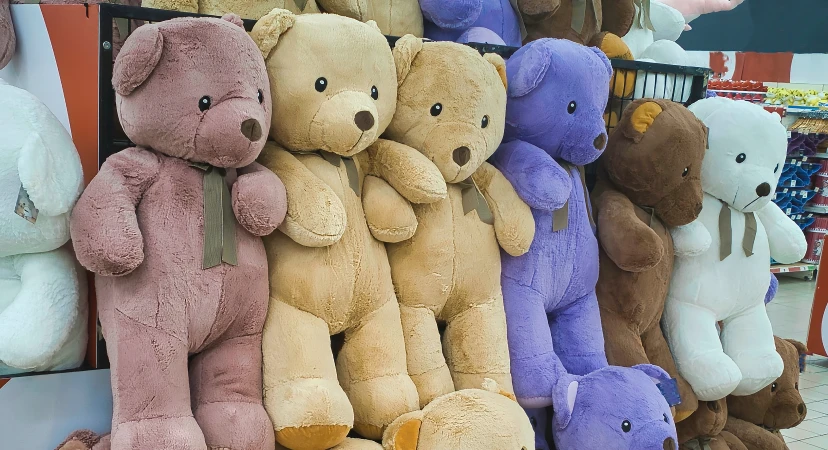
Claw machine plush toys are soft toys specified, filled, and sewn to perform inside a prize crane, where the claw is the hardest stress test the product will face. Unlike retail plush, which is designed for shelf appeal and hand feel, crane prizes must satisfy two opposing requirements: they have to look valuable enough to attract play, and they have to behave predictably under the claw so the operator can hold a target payout rate. Size, weight, fill density, fabric friction, seam strength, and center of gravity all feed directly into how often a machine pays out, and payout determines the profit of each unit on the floor. This guide covers the winnable size and weight window, fill engineering, fabric and durability standards, per-machine unit economics, prize compliance, mix and rotation planning, and the custom opportunities open to brands and IP owners in this channel.
Why Claw Machine Plush Is an Engineered Prize
A claw machine is a controlled probability device, but the prize is a physical variable the operator fully controls. Two toys at the same wholesale price can produce very different payout rates because of how they interact with the claw. A toy that is too light gets pushed around the pile instead of lifted. A toy that is too heavy cannot be raised at all by a standard claw. A toy with a slippery shell slides out of the grip during transport. An overfilled toy gives the claw nothing to close around.
Operators buy outcomes, and the outcome is a stable payout percentage against a known cost per play. That is why prize specifications in this channel read like engineering documents: gram weights, fill masses, tension thresholds, and claw ratios. Purpose-built claw machine plush exists because generic retail plush was never specified against these constraints.
Size and Weight: The Winnable Specification Window
Standard Size Classes
Commercial claw machine plush falls into four size classes. Mini prizes run 2 to 4 inches for compact cabinets and capsule-style play. Standard prizes, the volume class, run 7 to 11 inches. Jumbo prizes run 10 to 15 inches. Giant prizes run 16 to 36 inches, and cut-your-prize string machines typically use toys of 12 to 20 inches or larger. For a standard three-prong crane, the practical sweet spot is 7 to 10 inches: large enough to read as a real prize from outside the glass, small enough for the claw to close around.
The Claw Opening Ratio
A working rule used across the industry is that the toy's body width should be at least 1.5 times the claw's open span. Below that ratio the claw over-grips and the toy sits loose between the prongs; above roughly two times, the claw cannot wrap the body and grip depends entirely on surface friction. Specify the toy against the claw that will handle it, not against an abstract size chart.
Weight Bands and Lift Behavior
Weight is where most sourcing mistakes happen. The table below consolidates the operating ranges operators and manufacturers actually work with.
| Parameter | Specification | Behavior in the Machine |
|---|---|---|
| Sweet-spot size (standard 3-prong crane) | 7-10 in | Claw closes fully; stable, predictable grabs |
| Standard class size | 7-11 in | Volume class for most cabinets |
| Width-to-claw ratio | ≥1.5× claw open span | Prongs wrap the body instead of slipping past it |
| Medium toy weight (operator range) | 45-120 g | Liftable on machines with claw strength tuned to light prizes |
| Medium toy weight (premium range) | 150-220 g | Higher perceived value; needs verified claw power |
| Below 150 g on a standard-strength claw | — | Claw pushes the toy aside unless settings are matched; reads as cheap |
| Above 400 g | — | Standard claw cannot lift; machine appears unwinnable |
The two failure thresholds matter more than the averages. On a standard-strength claw, a toy under about 150 grams is light enough that the descending claw displaces it, and players interpret the machine as rigged. Machines set up for lighter prizes can run smaller toys successfully, but the claw power must be calibrated to the toy weight first. Over roughly 400 grams, a standard claw at typical power settings physically cannot lift the prize, which kills repeat play. Both extremes damage revenue, one through low perceived value and one through zero wins.
Fill Engineering and Its Direct Effect on Payout
Fill is the payout lever operators feel but rarely see specified. A medium claw prize typically carries 100 to 200 grams of polyester fiberfill. Inside that range, density is a tunable parameter.
- Overfilled toys are firm and round. A firm body gives the claw prongs no purchase; the grip slips during the lift and transport phases. Grab success drops, payout drops, and players may still feel the toy is winnable because it looks close. Some operators deliberately specify firmer fill for exactly this reason, where local claw-strength rules permit.
- Underfilled toys collapse under the claw. The claw gets an easy grip, win rates rise above plan, and the toy also looks deflated in the pile, which suppresses play volume.
- Rebound test: the production standard is that a fully compressed toy recovers its shape within 3 seconds. Slower rebound signals degraded fiberfill or insufficient fill mass, and fast, full rebound signals a fill density in the functional window.
Fill consistency across a batch matters as much as the target itself. If fill mass varies by 20 percent between units, one machine on the route pays out at 15 percent and an identical machine pays out at 28 percent. Specify fill weight with a tolerance in the production contract, and weigh samples from the bulk run, not only the approval sample.
Fabric Selection and Grip Performance
Shell fabric controls the coefficient of friction between the claw and the toy, and friction decides whether a gripped toy survives the trip to the chute. Short-pile fabrics, specifically velboa and minky, are the standard for crane prizes: soft to the hand, resistant to abrasion against glass and other toys, and textured enough for metal prongs to hold. Operator and supplier testing indicates that higher-friction shells, such as velvet-type constructions, can raise grab success rates by roughly 20 to 30 percent against a slick shell at identical claw settings.
Two fabric categories work against the operator. Satin-smooth and silky polyester shells slide out of the grip during transport, producing the frustrating near-win pattern that players read as unfair. Long-pile faux fur compresses under the prongs and offers no stable surface, and it also mats and sheds inside the cabinet. Fabric options and their trade-offs are detailed on the materials page. Beyond grip, specify anti-pill short pile and tested colorfastness: a prize that pills or bleeds color after a month inside a lit cabinet drags down the perceived value of the entire machine.
Durability Acceptance Checklist for Machine Environments
A crane prize lives a harder life than a shelf toy. It is dropped onto hard surfaces, crushed under other stock, dragged across glass, and squeezed by metal prongs hundreds of times before it is won. The following acceptance points reflect what should be checked on the approval sample and on bulk-run units.
- Seam construction: double-stitched or reinforced seams throughout; single-line chain stitching is not acceptable for this channel.
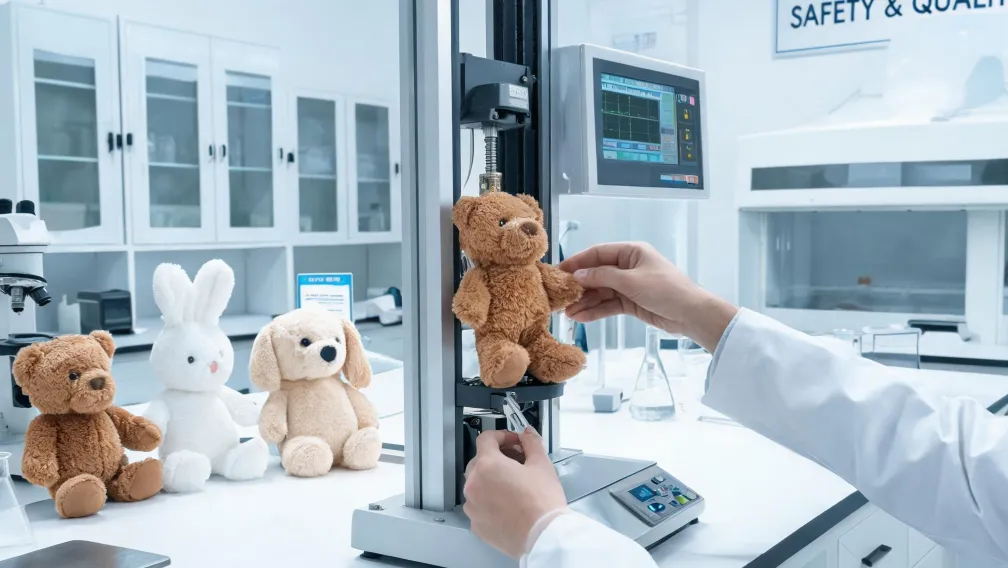
- Stress-point tension: limbs, neck joins, and ears withstand at least 12 N of pull force without seam opening or detachment. These are the points the claw catches and the points children pull first.
- Eyes and nose: embroidered features are preferred. Glued plastic safety eyes detach under repeated claw compression and create a small-parts hazard in the prize chute.
- Labels: sewn fabric labels survive machine friction; paper hang tags tear off inside the cabinet and leave litter in the pile.
- Surface durability: anti-pill short pile with verified colorfastness; the toy must look sellable after months of abrasion.
- Fill recovery: full shape recovery within 3 seconds after full compression, tested on multiple units per carton.
Unit Economics: Prize Cost, Payout Rate, and Revenue per Machine
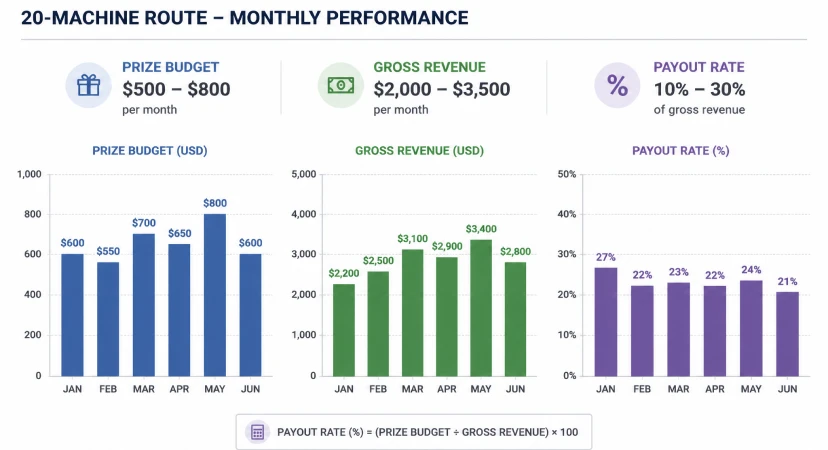
The claw machine business model reduces to three linked ratios, and the prize sits inside all of them. The payout rate, the share of plays that produce a win, typically runs between 10 and 30 percent depending on venue strategy. The prize cost should sit at 20 to 30 percent of the price per play. Wholesale prices for standard claw plush in the 15 to 30 centimeter band generally run $1 to $6 per piece depending on size, fabric, and licensing.
The long-run operator rule of thumb is that a winning player spends approximately three to four times the prize's wholesale cost before winning it. The table below shows a monthly model for a 20-machine route using current operator benchmarks.
| Line Item | Benchmark | 20-Machine Monthly Example |
|---|---|---|
| Payout rate | 10-30% of plays | Set per venue; tested weekly |
| Prize cost vs. play price | 20-30% | $0.25-$0.30 prize budget per $1 play |
| Wholesale prize cost | $1-6 per piece (15-30 cm) | Blended $2-3 across the mix |
| Player spend per win | 3-4× prize wholesale cost | $6-12 revenue per prize dispensed |
| Prize budget | Scaled to win volume | $500-800 per month across the route |
| Gross revenue | — | $2,000-3,500 per month across the route |
The procurement conclusion from this model is that prize cost is a small expense with outsized impact. Saving $0.30 per unit on a cheaper toy that plays badly in the claw can cost multiples of that in reduced play volume, while a correctly specified toy pays for itself through a stable, visible win rate.
Prize Compliance: CPSIA and ASTM F963 Still Apply
A persistent misconception in the amusement channel holds that prizes are exempt from toy safety rules because they are won rather than sold. This is incorrect. Plush prizes are children's products under US law regardless of whether they are sold at retail or dispensed from a machine, and they must comply with CPSIA and ASTM F963. The core requirements mirror those of retail plush.
- Small parts (ASTM F963 Section 4.6): no detachable small components on items that can reach children under 3; this is why embroidered eyes are the production default for crane prizes.
- Lead limits: maximum 90 ppm in surface coatings and 100 ppm in accessible substrates.
- Flammability (Section 4.2): shell fabrics must pass the standard's burn-rate requirements.
- Phthalates: capped at 0.1 percent for listed compounds in any plasticized components.
On top of federal toy law, many US states and municipalities cap the value of prizes a machine may award. Ohio, for example, applies a $10 wholesale prize value ceiling, and Chicago applies a $5 limit. These caps directly shape what can be stocked, particularly for licensed and jumbo items, so verify local rules with counsel or your route association before committing inventory. Testing workflows and documentation are covered on the safety and compliance page and in the plush toy safety standards guide.
Prize Mix, Rotation, and the Sourcing Calendar
Demand in this channel is expanding with the venue base. Market Data Forecast values the global family entertainment center market at approximately $34.6 billion in 2024, with a compound annual growth rate near 10 percent, and IAAPA reports that FECs in North America and Europe received more than 380 million visits in 2023. More cabinets in more venues means more prize volume, and it also means prize programs are becoming more deliberate.
Licensed Anchors and Generic Fill
The standard mix for a well-run cabinet is 30 to 40 percent licensed merchandise positioned at the top and center of the pile, supported by 60 to 70 percent generic plush filling the cabinet volume. Licensed pieces act as anchors: according to operator and supplier data, recognizable characters measurably increase plays per machine, which is why they carry the visible positions even though they cost more per unit. Generic pieces carry the payout volume at controlled cost.
Rotation and Lead Times
Prize fatigue is real: a cabinet that never changes stops earning. The operating norm is to rotate 30 to 50 percent of the stock every 2 to 4 weeks. Seasonal programs, such as holiday or summer film tie-ins, require purchase orders placed 2 to 3 months ahead of the selling window, because ocean freight alone runs 30 to 40 days from East Asia to North American ports. A sourcing calendar that works backward from the rotation date, with freight and production time deducted, is the difference between a seasonal program that lands and one that arrives in the off-season.
Custom Claw Machine Plush: Design Opportunities for Brands and IP Owners
Brands and IP owners increasingly treat claw machines as a distribution channel rather than an afterthought, and custom prizes for this channel require design decisions made at the pattern stage, not after production. Three engineering points belong in the design brief. First, grab points: a protruding head, a thick torso, and clearly separated limbs give the claw something to hook, and these shapes should be drawn into the pattern deliberately. Second, center of gravity: weight biased low lets the toy sit upright in the display pile and raises the skill requirement of the grab, both desirable outcomes. Third, hanging hardware: giant prizes for cut-your-prize machines need reinforced hang loops tested well beyond the toy's own weight, because a failed loop drops the prize without a win and voids the play.
Programs of this kind combine licensed character work with channel-specific engineering. The licensing workflow is covered in the custom plush for brand and IP licensing guide. Maris Plush has manufactured plush for 18 years and supplies claw machine programs for arcade and FEC operators, prize wholesalers, and IP holders. To discuss specifications, request samples, or price a program, contact our team with your target size class, quantity, and destination market.
FAQ
For a standard three-prong crane, the sweet spot is 7 to 10 inches, within the standard commercial class of 7 to 11 inches. Mini prizes run 2 to 4 inches, jumbo prizes 10 to 15 inches, and giant prizes 16 to 36 inches, with cut-your-prize machines typically using toys of 12 to 20 inches or larger. Whatever the class, the toy's body width should be at least 1.5 times the claw's open span so the prongs can wrap and hold the body.
Standard claw plush in the 15 to 30 centimeter band generally wholesales at $1 to $6 per piece, depending on size, fabric, fill quality, and licensing. Licensed characters and jumbo sizes sit at the top of the range. A blended cost of $2 to $3 across a mixed cabinet is a common working figure for route operators.
Most venues target a payout rate between 10 and 30 percent of plays, set through claw strength and prize specification together. The prize cost itself should sit at 20 to 30 percent of the price per play. The operator rule of thumb is that a winning player spends roughly three to four times the prize's wholesale cost before winning it, so a stable, visible win rate is what drives repeat revenue.
Do claw machine prizes have to meet toy safety standards?
Yes. Plush prizes are children's products under US law whether they are sold or dispensed from a machine, so CPSIA and ASTM F963 apply in full: small-parts rules under Section 4.6, lead limits of 90 ppm in coatings and 100 ppm in substrates, flammability under Section 4.2, and phthalates capped at 0.1 percent. Many states and cities also cap prize values, such as Ohio's $10 wholesale ceiling and Chicago's $5 limit, so confirm local rules before stocking.
The standard cabinet mix is 30 to 40 percent licensed merchandise and 60 to 70 percent generic plush. Licensed pieces are placed at the top and center of the pile as anchors, because operator and supplier data shows recognizable characters measurably increase plays per machine. Generic pieces carry the actual payout volume at a controlled cost per win.
The operating norm is to rotate 30 to 50 percent of cabinet stock every 2 to 4 weeks, since a cabinet that never changes stops earning. Seasonal programs should be ordered 2 to 3 months ahead of the selling window to absorb production time plus 30 to 40 days of ocean freight.
Operators and wholesalers typically source through three channels: prize wholesalers holding ready stock with low minimums, direct factory orders for custom programs, and licensed collections ordered through the rights holder's approved manufacturer. Direct factory production suits custom designs, brand or IP programs, and buyers consolidating volume across a route; it offers the lowest unit cost in exchange for higher minimums and production lead time. A manufacturer with claw machine experience can quote against size class, weight band, and compliance market rather than a generic plush spec.