Giant Custom Plush Toys: A B2B Engineering, Structure, and Logistics Guide
Manufacturing giant plush toys—defined industrially as items exceeding 80 cm (32 inches) in height and often reaching up to 250 cm (8 feet)—requires a complete departure from standard soft toy production methods. A 20 cm retail plush toy relies entirely on the density of its internal polyester fiberfill to maintain its shape. When scaled to 150 cm, the physical mass of the fabric and stuffing causes the structure to collapse under its own weight. Producing oversized plush for retail displays, event marketing, carnival prizes, or premium character installations is an exercise in structural engineering and volumetric freight management.
This guide details the manufacturing specifications required for commercial giant plush production. It covers internal armature engineering, non-linear pattern grading, fabric tensile requirements, flammability compliance for public displays, and the industrial vacuum compression techniques necessary to make international ocean freight economically viable.
The Structural Engineering of Oversized Plush
How do manufacturers keep giant plush toys from collapsing?
Manufacturers prevent giant plush toys from collapsing by installing internal rigid armatures made of PVC piping, EVA foam columns, or articulated metal joints, combined with a heavily weighted base. Instead of relying solely on polyester fiberfill, the factory builds a load-bearing internal skeleton that supports the weight of the oversized head and torso, while high-density PP cotton is packed tightly around the frame to provide the soft outer texture. The base is filled with sealed sandbags or weighted microbeads to lower the center of gravity, ensuring the toy stands upright without tipping over.
Gravity dictates the design of giant plush. A large character head represents massive top weight. Without internal support, the neck seam will buckle, causing the head to slump forward permanently within days of deployment. B2B buyers must stipulate their structural requirements based on the specific end-use environment.
Internal Armatures and Skeleton Materials
The choice of internal skeleton directly impacts the unit cost, weight, and posability of the giant plush toy.
PVC and Polycarbonate Piping
For static standing or sitting displays, industrial PVC or polycarbonate piping forms the most common internal frame. The factory engineers a t-bar or cross-frame structure mimicking the spine and shoulders of the character. The piping is wrapped tightly in high-density foam to prevent the hard plastic from wearing through the outer fabric over time. This method is highly cost-effective and provides permanent structural rigidity for retail window displays.
EVA Foam Cores
For giant plush toys that require more flexibility or need to be hugged by consumers (such as oversized carnival prizes), factories utilize high-density EVA foam blocks carved into the core shape of the torso and head. The foam acts as a solid, lightweight foundation. A layer of standard PP cotton is wrapped around the EVA core to soften the tactile feel. This eliminates the risk of a consumer hitting a hard plastic pipe while interacting with the toy.
Articulated Metal Joints
Premium studio displays and high-end mascot replicas occasionally require posability. Factories insert heavy-gauge wire or articulated ball-and-socket metal joints into the limbs. This allows event staff to bend the arms or legs into specific poses. Because metal joints add significant weight and cost, they are strictly reserved for low-volume, high-budget corporate installations.
Fabric Tensile Strength and Seam Reinforcement
The outer shell of a giant plush toy must contain up to 30 pounds of internal stuffing and framing. Standard 150 GSM plush fabric will tear under this outward pressure, and standard single-stitching will burst along the stress points.
Factories upgrade the textile specifications for oversized builds. Outer fabrics—such as Velboa, PV fleece, or synthetic fur—must possess a density of 300 GSM to 400 GSM. Furthermore, the fabric panels are often fused with a secondary non-woven backing layer before cutting. This backing eliminates the lateral stretch of the knit, locking the fabric dimensions in place.
Seam engineering is equally critical. Professional manufacturers utilize industrial double-overlock stitching with high-tensile nylon thread. Stress points, specifically where the limbs attach to the torso and the neck supports the head, receive additional bar-tack reinforcement. The final closure seam, which is sewn by hand after the internal frame and stuffing are inserted, is executed using a heavily anchored ladder stitch.
Non-Linear Pattern Grading and Gravity Compensation
A common error in giant plush procurement is assuming a factory can simply scale up a 20 cm pattern by 500 percent to create a 100 cm toy. This linear scaling fails because it ignores physics.
When a pattern is enlarged linearly, the volume (and therefore the weight of the stuffing) increases exponentially. A head that looks perfectly round at 20 cm will flatten into an oval at 100 cm due to the weight of the stuffing pulling the fabric downward. Factory pattern engineers must manually redraw the oversized cut files, deliberately distorting the shapes—making heads taller and limbs thicker at the base—to compensate for this gravitational sag. Buyers should expect a full 7 to 14-day prototyping phase to engineer a giant plush pattern from scratch, even if a small version of the character already exists.
Weight Distribution and Center of Gravity
A 6-foot standing plush bear presents a significant tipping hazard. If placed in a high-traffic retail environment, an unstable giant plush is a liability. Manufacturers stabilize oversized toys by drastically lowering the center of gravity.
This is achieved by engineering a dense, weighted base. The factory seals sand, heavy rubber pellets, or glass microbeads inside heavy-duty canvas pouches. These pouches are locked into the lowest extremities of the pattern—the feet, legs, or bottom torso. The upper sections of the toy are then stuffed with ultra-lightweight PP cotton. This intentional weight disparity anchors the display firmly to the floor.
Safety Compliance and Flammability Standards
Giant plush toys deployed in commercial spaces (malls, cinemas, trade shows) face strict regulatory scrutiny. While standard mechanical tests for choking hazards still apply if the item is accessible to children, flammability is the primary compliance hurdle for oversized displays.
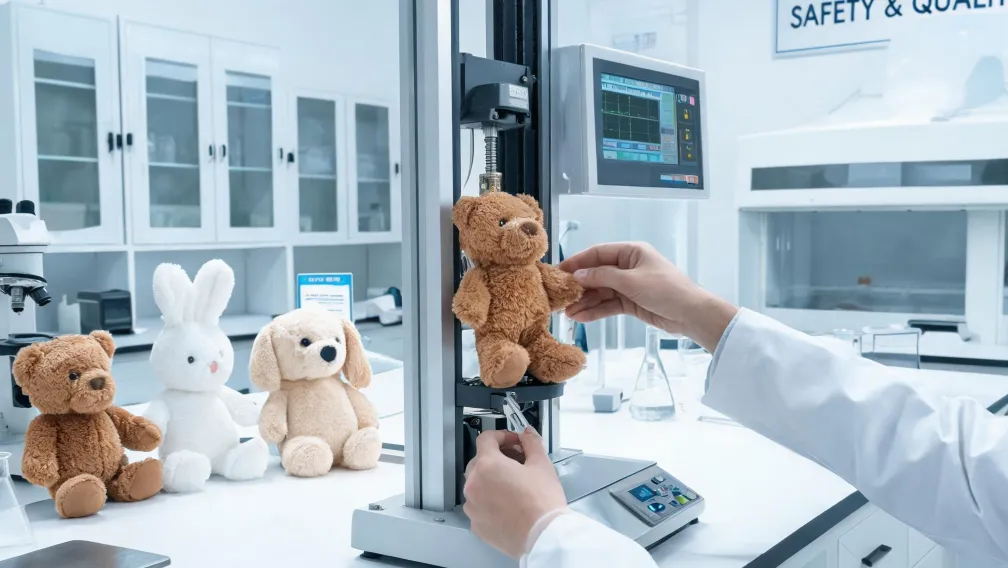
Fire marshals and venue operators frequently require documentation proving the display materials meet specific fire safety codes. Buyers must mandate compliance with EN 71-2 (Europe) or 16 CFR 1500.44 (United States) flammability standards. For major commercial installations, factories can apply specialized non-toxic fire-retardant chemical treatments to the outer fabric and internal foam cores before assembly. Importers must request batch-specific laboratory test reports from accredited third parties like SGS or Intertek prior to shipment. Find more on our compliance capabilities on the safety and compliance page.
Volumetric Freight Logistics and Vacuum Compression
The primary barrier to executing a giant plush campaign is not the manufacturing cost, but the international ocean freight. Ocean carriers bill based on volumetric weight (CBM - cubic meters). Shipping a container of fully expanded 6-foot plush toys means the buyer is essentially paying to ship trapped air.
Industrial vacuum compression is mandatory for oversized plush logistics. The factory places the finished toys into heavy-duty, multi-layer plastic sleeves. High-powered industrial vacuums extract the air, and the sleeve is heat-sealed. This process compresses a giant plush toy into a dense, flat disc, reducing its shipping volume by up to 60 percent. This allows buyers to double the unit count per 40-foot shipping container.
Upon arrival, the buyer cuts the vacuum seal. The PP cotton aggressively draws in air, and the toy regains 90 percent of its volume within minutes. A standard industrial garment steamer or manual fluffing is typically required to remove fabric wrinkles and restore the final 10 percent of the volume.
Initiating a Giant Plush Manufacturing Project
Executing an oversized custom plush project requires a manufacturer with specific large-scale cutting tables, specialized internal framing capabilities, and heavy-duty vacuum sealing equipment. Trading companies or small boutique factories generally lack the floor space and machinery to process these items efficiently.
When submitting a request for quotation, clearly define the intended use case (e.g., untouchable window display vs. interactive photo-op prop). This informs the engineering team whether to quote a rigid PVC frame or a soft EVA core. Review our production specifications for giant plush toys and submit your tech pack to receive an itemized cost analysis detailing both the unit production price and the optimized volumetric freight estimate.
FAQ
Giant plush toys typically start at 80 cm (32 inches) and can reach up to 250 cm (8 feet) or larger. Any plush item over 100 cm generally requires internal structural armatures to prevent the weight of the fabric and stuffing from collapsing the design.
No. Scaling a small pattern linearly ignores gravity. The exponential increase in stuffing weight causes large versions to sag and distort (e.g., a round head becomes oval). Factory pattern engineers must redraw the oversized cut files to compensate for gravitational pull and internal volume changes.
To prevent collapsing, manufacturers build internal skeletons using industrial PVC piping, carved EVA foam blocks, or articulated metal wire. High-density PP cotton is stuffed around this frame, giving the toy external softness while maintaining a rigid, load-bearing internal structure.
Giant plush toys are stabilized by lowering their center of gravity. Factories place heavy, sealed canvas pouches filled with sand or rubber pellets into the base or feet of the toy, ensuring it anchors firmly to the floor and resists tipping in high-traffic commercial environments.
Yes. Commercial venues like malls or trade shows often require strict fire safety documentation. The plush must pass EN 71-2 (EU) or 16 CFR 1500.44 (US) flammability testing. Factories can apply non-toxic fire-retardant treatments to the fabrics if required by local fire marshals.
Giant plush toys are placed in heavy-duty plastic sleeves, and industrial machines extract the air before heat-sealing them. This vacuum compression reduces the shipping volume (CBM) by up to 60 percent, drastically cutting ocean freight costs. The toys expand back to normal size once unsealed.