Custom Mascot Costume: A B2B Buyer's Guide to Sourcing a Wearable Brand Asset
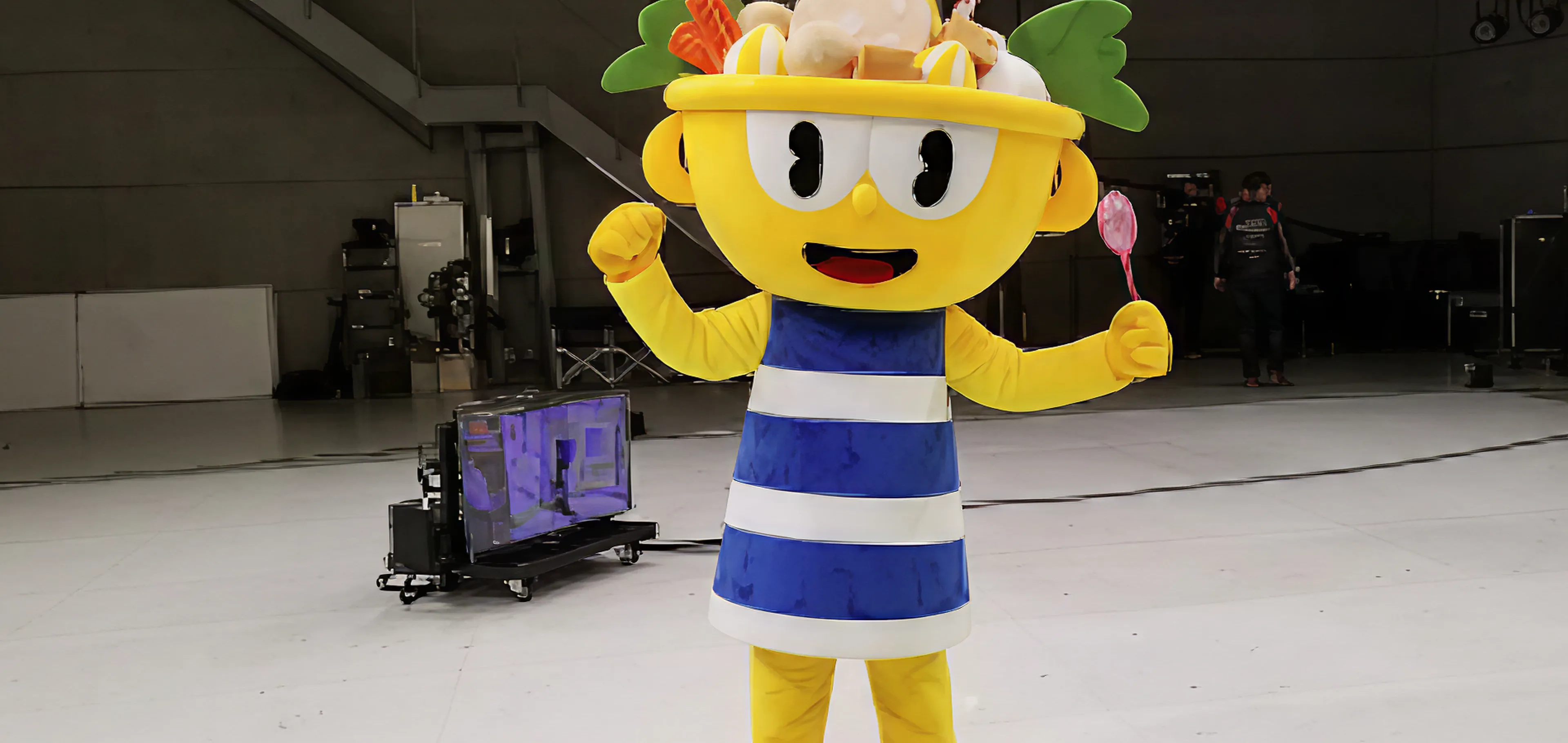
A custom mascot costume is a wearable piece of branded equipment: a performer operates inside it, in front of live audiences, often in heat, for hours at a time. That operating condition makes procurement an engineering decision. Head construction, ventilation, internal structure, weight, and field of vision determine whether the costume can perform safely at an event; fabric, color control, and archival records determine whether it still represents the brand in year five. These variables separate a mascot costume from a mascot plush toy, which is batch merchandise judged on shelf appeal. This guide covers the full procurement cycle for brands, sports organizations, event marketing agencies, and venue operators: market context, head construction methods, internal structure, vision and ventilation, weight and wearing limits, hot-climate specification, price bands, production timelines, international shipping, and a delivery acceptance checklist.
The Market Behind Mascot Programs
Industry estimates based on Grand View Research data put the mascot sector on a compound annual growth rate of about 6.8 percent, with the market projected to reach roughly $1.7 billion by 2032. Growth concentrates where live entertainment investment concentrates. The Middle East is the clearest case: CMI values Saudi Arabia's entertainment and events market at approximately $13 billion in 2025, rising to $34.2 billion by 2035 at a 12.8 percent CAGR. Riyadh Season alone drew more than 12 million visitors in a single season, and the national pipeline extends through Expo 2030 and the FIFA World Cup 2034. For procurement teams in Europe, Central Asia, and the Middle East, this growth changes the buying logic. A mascot costume working a seasonal festival or a national event program appears in front of millions of attendees, and its construction quality is visible in every photograph. Buyers in these markets increasingly treat the costume as capital equipment with a multi-year service plan, and they specify it the way they would specify any other piece of event hardware.
Mascot Costume vs. Mascot Plush: Two Products, Different Standards
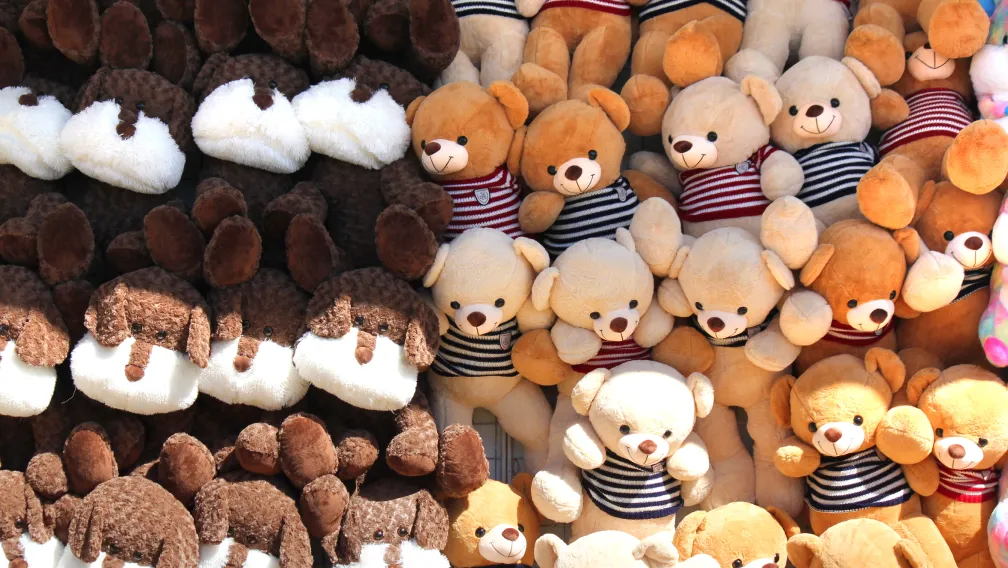
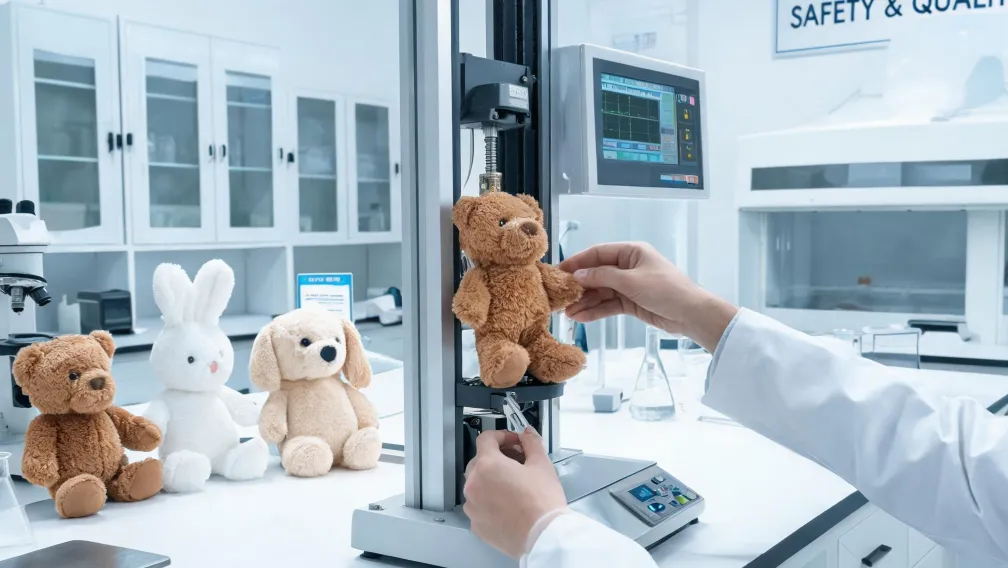
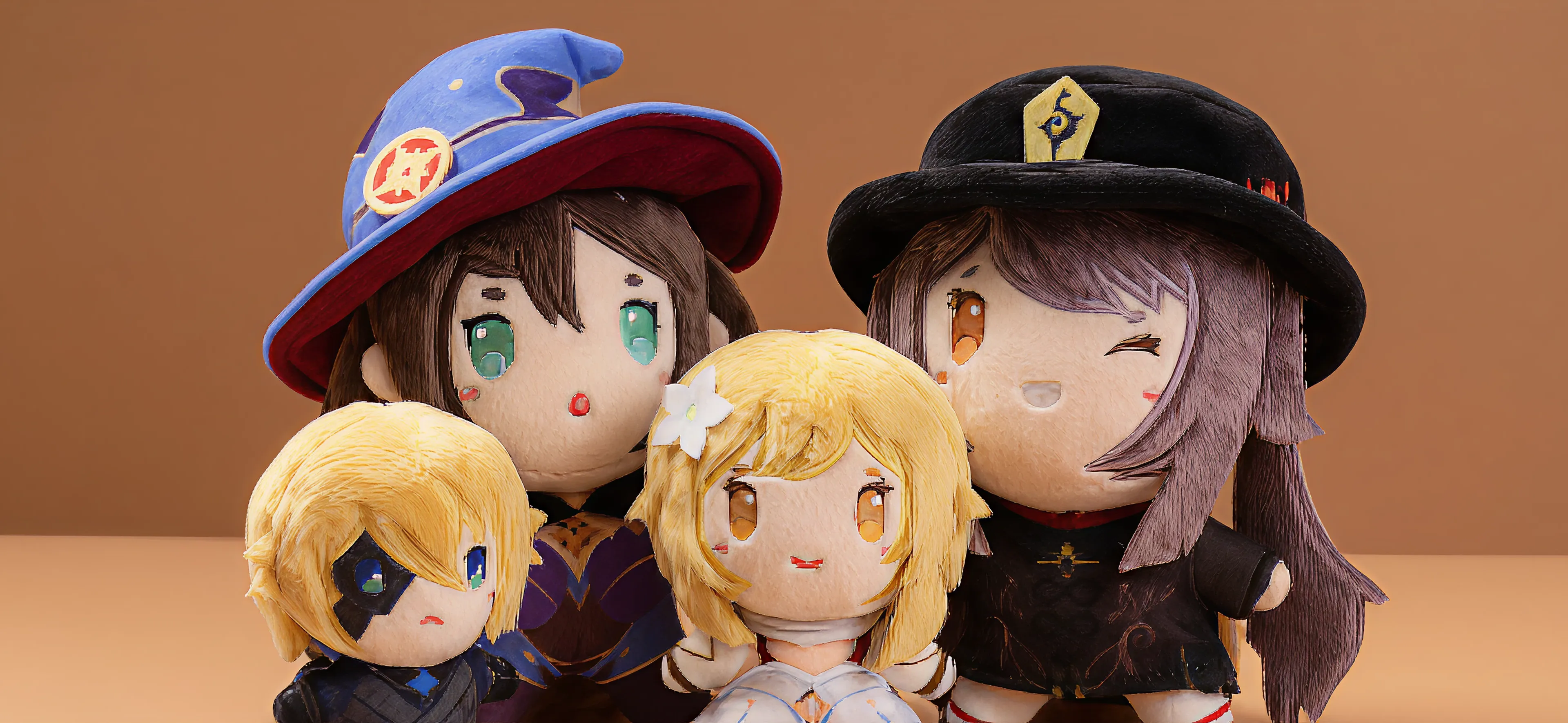
The distinction matters because the two products follow different quality standards and different failure modes. A mascot plush toy is batch merchandise, produced in the hundreds or thousands and judged on shelf appeal and safety compliance; its production workflow is covered in our custom mascot plush production guide, and the product line itself on the custom mascot plush page. A mascot costume is a single handmade unit with a person inside. Its quality standards are mechanical and ergonomic: how much the head weighs, where the performer can see, how heat escapes, and how fast a damaged hand can be swapped before the next appearance. A plush toy that fails a seam test is a defect rate; a costume that fails in use is a performer with heat exhaustion at a live event. Procurement teams therefore evaluate custom mascot costumes the way they evaluate technical equipment: specification first, sample inspection against the specification, and a maintenance plan for the full service life.
Head Construction: Four Methods Compared
The head carries the character's identity and most of the performer's burden, and four construction methods dominate the market. The method determines weight, unit-to-unit consistency, lead time, and what happens to the costume in a hot warehouse.
EVA Closed-Cell Foam, Thermoformed
EVA closed-cell foam, heat-formed over molds, is the mainstream method among Chinese factories. The foam is light, consistent between units, and fast to produce once the mold exists, which suits programs with repeat orders. Its weakness is heat: EVA softens and deforms under extreme temperatures, a real consideration for Middle East deployment and desert shipping routes. The transport and storage controls this requires appear in the hot-climate section below.
Hand-Carved PU Foam
Hand-carved polyurethane foam is the mainstream method among US professional builders. A sculptor carves the head from a foam block, which allows organic shapes, expressive detail, and one-off designs without tooling cost. Output depends on the individual sculptor, so consistency between units runs lower and lead times run longer.
Fiberglass Molds
Fiberglass produces rigid, dimensionally exact heads and suits designs with moving jaws or mechatronic structures, where a rigid shell carries the mechanism. The trade-offs are weight and cost: fiberglass heads are the heaviest and most expensive option. Any head in the 5 to 15 pound range is a red flag for performer safety, whatever the material.
3D Printing
3D printing is the emerging option. Printed heads reproduce CAD geometry exactly, integrate mounts for fans or animatronics, and suit projects that start from a 3D character model. Build volume and print time still limit head size, and printed parts need finishing work before fur application.
| Method | Where It Dominates | Weight | Consistency | Best Fit |
|---|---|---|---|---|
| Thermoformed EVA foam | Chinese factories | Light | High, mold-based | Repeat orders, standard characters |
| Hand-carved PU foam | US professional builders | Light to moderate | Sculptor-dependent | One-off expressive designs |
| Fiberglass | Specialty shops | Heavy; 5-15 lb heads are a red flag | Very high | Moving jaws, mechatronics |
| 3D printing | Emerging | Moderate | Exact to CAD | 3D-modeled characters, integrated mounts |
Ask shortlisted manufacturers which method they use and why it fits your character. The answer shows whether the factory proposes its strongest process or the process the design needs.
Internal Structure: Helmet, Body, Feet, and Hands
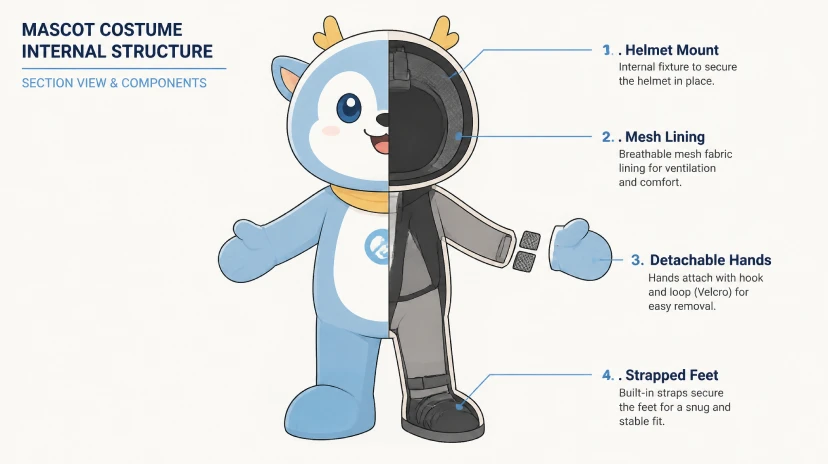
The structure inside the costume determines whether a performer can work safely through a full event day. Four elements belong in every written specification.
Helmet Mounting
The head mounts on a helmet inside the shell, typically a hockey-style helmet with a chin strap, adding roughly 0.5 to 1 pound. The helmet fixes the head's position relative to the performer's eyes, which keeps the vision windows aligned, and it spreads the load across the skull rather than the neck. Specify the helmet type in writing, since a loose foam head with no helmet shifts during movement and blocks the performer's sight line.
Body and Abdomen
The body wears over an athletic mesh lining that wicks sweat and separates the performer from the foam. For hot climates, the abdomen can replace foam with a PVC pipe and mesh skeleton, which holds the character's silhouette while letting air pass through the torso. The silhouette stays intact; the heat load drops.
Feet
The feet contain internal straps, and the performer wears personal shoes inside them. This gives the performer proper footwear for hours of standing and walking, and it keeps the costume feet replaceable when the outer soles wear through.
Hands
Hands attach with Velcro and snaps and are designed to detach. Hands take more abuse than any other component: they touch rails, doors, pens, and hundreds of audience members per event. Detachable hands can be washed, repaired, or replaced without taking the costume out of service.
Vision and Ventilation: What the Performer Actually Gets
A performer inside a mascot head works with a fraction of normal vision while heat builds around the face. The specification should state exactly what the performer gets.
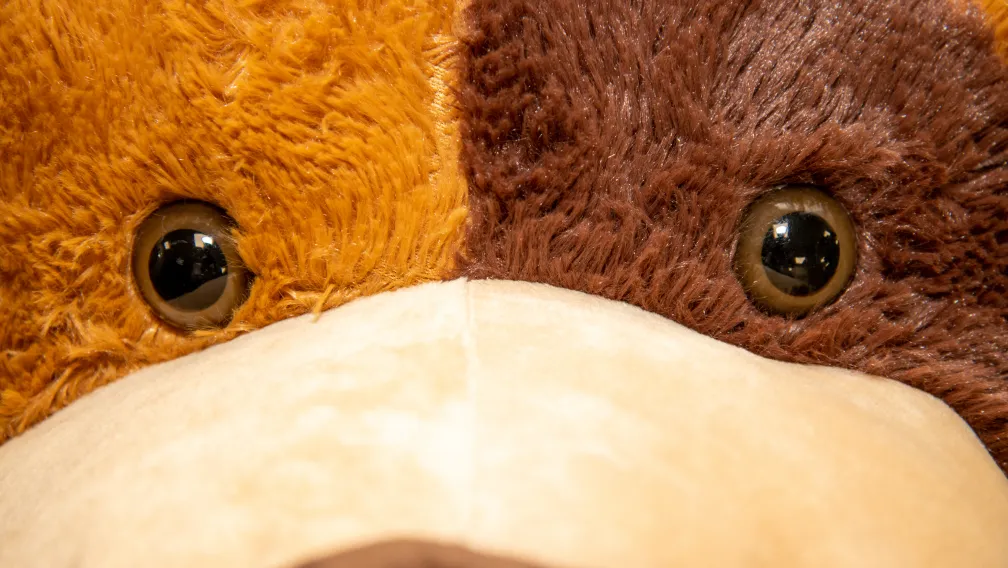
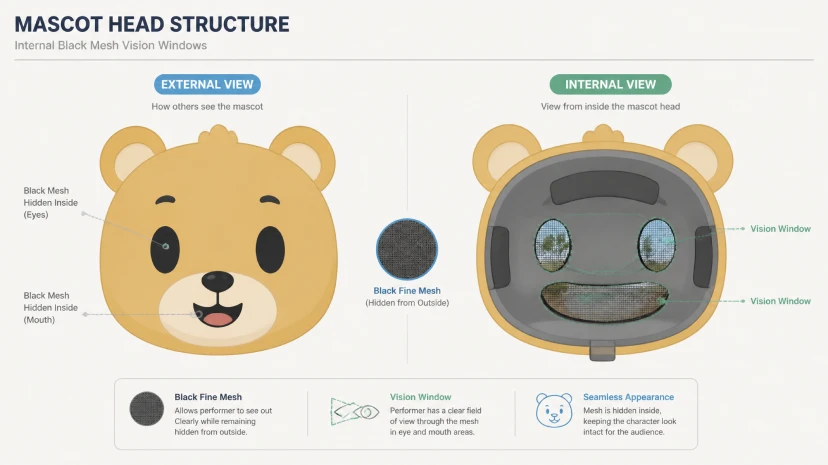
Vision windows are panels of dark, fine mesh hidden behind the character's eyes, mouth, or nostrils. From outside, the mesh reads as shadow; from inside, the performer sees through it with reduced brightness. Dark interior lining cuts glare inside the head and improves outward visibility. Peripheral vision drops sharply in any full-head design, so live appearances require a handler or spotter walking with the character to manage stairs, cables, and children approaching from the side.
Ventilation starts with exhaust vents at the crown, where hot air collects. Chinese factories fit battery-powered fans inside the head as standard. The US professional school argues against built-in fans: wires fatigue and break inside a foam shell, and a failed fan leaves a dead battery pack strapped inside a hot head. Both positions have a basis in field experience. The practical resolution is to specify fan units mounted for access and replacement, or to rely on passive venting plus a cooling vest where climate and budget allow.
Weight, Sizing, and Wearing Duration
Full costumes weigh 8 to 25 pounds. A typical build runs about 12 pounds: roughly 4 pounds of head and 8 pounds of body. Head weight drives fatigue, so specify 2 to 3 pounds where the design allows. Standard sizes fit performers from 5'4" to 6'2" (162 to 188 centimeters); special sizing adds cost and extends the pattern work.
Wearing duration is a safety specification, and hot climates tighten it. The working limits below combine OSHA heat index categories with standard mascot industry practice.
| Condition | Maximum Wear Time | Rest Between Sets |
|---|---|---|
| Indoor, air-conditioned | Up to 60 minutes | 10-15 minutes |
| Outdoor, hot weather | 20-30 minutes | 15-20 minutes of cooling |
| Heat index above 95°F (35°C) | 15 minutes or less | Full cooldown after each set |
Schedule outdoor appearances before 10 a.m. or after 6 p.m. where the event program allows. These limits define staffing: a two-hour outdoor appearance in summer needs several performers rotating through one costume, or several costumes.
Hot-Climate Specification for the Middle East
Projects for the Gulf, the wider Middle East, and Central Asia need a heat-specific build sheet. The standard measures are lightweight fabrics and light-colored fur, which absorb less radiant heat; additional ventilation ports beyond the standard crown vents; pre-cooling of the costume before each set; and a cooling vest worn under the body. Fabric options for these builds appear on our materials page.
One material caution applies to shipping and storage as much as to performance: EVA foam softens and deforms in extreme heat. A costume left in a closed container on a Gulf dock, or stored in an unconditioned warehouse between seasons, can arrive or emerge with a warped head. Specify temperature-controlled transport and air-conditioned storage for EVA-based builds, and assign responsibility for each stage in the contract.
Price Bands, Maintenance, and Total Cost of Ownership
Mascot costumes sell in three build classes. The right comparison is cost per year of service, since service life differs by a factor of five or more between classes.
| Build Class | Price | Lead Time | Service Life |
|---|---|---|---|
| Stock (off-the-shelf) | $500-2,000 | Immediate | 1-2 years |
| Semi-custom | $2,000-5,000 | 6-8 weeks | 3-5 years |
| Full custom | $5,000-15,000+ | 12-16 weeks | 7-10+ years |
Lead times in this table reflect US workshop norms. Chinese factory production for the same full-custom tier typically runs 45 to 60 days after design approval.
Built-in options add to the base price: cooling systems run $300 to $1,000 and up, and internal harnesses run $300 to $800. With proper maintenance, a quality custom costume can remain in service for up to 20 years.
Maintenance is simple and mostly washable. The body goes through a cold machine wash in a machine without an agitator; the head is hand-washed only. Hands and feet are high-wear parts designed as replaceable items, and routine repairs run $50 to $150 for simple work and $200 to $500 or more for head repairs. A manufacturer who archives your patterns, molds, and color references can refurbish or replicate the costume years later without new tooling, so confirm the archival practice in writing before ordering.
Production Process, Shipping, and the Acceptance Checklist
The production sequence runs design (two to three weeks), prototyping, construction (six to twelve weeks), quality control, and delivery. US workshops quote twelve to sixteen weeks end to end; Chinese factories typically complete production in 45 to 60 days. Payment follows the industry norm of 50 percent deposit with the 50 percent balance before shipment. Choosing between regions involves more than lead time, and our guide to choosing a manufacturer covers the evaluation framework.
International shipping bills by dimensional weight, because the costume's volume exceeds its scale weight. A typical shipment packs at 60 x 60 x 60 centimeters and 6 to 8 kilograms per carton, with the head, body, hands, and feet boxed separately. Foam parts must never be vacuum-compressed; compression leaves permanent dents. Import duties sit with the buyer, and HS classification for mascot costumes varies by market, so confirm the code and duty rate before the goods ship.
Work through this ten-point checklist when the costume arrives:
- Head weight: weigh the head against the quoted figure.
- Helmet type: confirm the helmet model and chin strap inside the shell.
- Vision windows: locate the mesh panels and test the field of view from inside.
- Crown vents: check the exhaust vents for open airflow.
- Detachable hands and feet: verify the Velcro and snap attachments work as specified.
- Lining material: inspect the interior lining against the specification.
- Washability: confirm the washing instructions for head and body in writing.
- Colorfastness: test dye stability on an inconspicuous seam.
- IP ownership: file the written copyright and design assignment from the manufacturer.
- Shipping terms: reconcile the freight invoice against the quoted dimensional weight and duty terms.
Maris Plush has manufactured custom plush and mascot products for 18 years for brands, sports organizations, event marketing agencies, and venue operators, with recent programs across Europe, Central Asia, and the Middle East. Send your character artwork, performer height range, event climate, and target in-service date through the contact page, and the team will return a build specification and quotation with a production schedule.
FAQ
Stock costumes run $500 to $2,000 with a service life of one to two years. Semi-custom builds run $2,000 to $5,000 and last three to five years. Fully custom costumes run $5,000 to $15,000 or more and last seven to ten years or longer. Built-in options add cost: cooling systems run $300 to $1,000 and up, and internal harnesses run $300 to $800. Compare quotes on cost per year of service, since a $10,000 costume used for ten years costs about $1,000 per year, while a $1,500 stock costume replaced every year or two costs the same or more and delivers a weaker brand image.
Design takes two to three weeks, followed by prototyping, six to twelve weeks of construction, quality control, and delivery. US workshops quote twelve to sixteen weeks end to end, while Chinese factories typically complete production in 45 to 60 days. Payment follows the industry norm of 50 percent deposit and 50 percent balance before shipment. Schedule backward from the event date and reserve time for international shipping.
Look at the character's eyes, mouth, and nostrils in close-up photographs. Vision windows are panels of dark, fine mesh hidden behind these features, so they read as shadowed areas at close range. In daylight, angle the head and look for the mesh texture behind the eye or mouth openings. If you cannot locate any mesh panel, ask the manufacturer directly, since some budget heads place the window where the performer cannot see forward.
Indoors with air conditioning, limit sessions to 60 minutes with 10 to 15 minutes of rest between appearances. Outdoors in hot weather, cut sessions to 20 to 30 minutes with 15 to 20 minutes of cooling between sets. At a heat index above 95°F (35°C), limit wear time to 15 minutes or less, following OSHA heat index guidance. Where the program allows, schedule outdoor performances before 10 a.m. or after 6 p.m.
Full costumes range from 8 to 25 pounds. A typical costume weighs about 12 pounds: roughly 4 pounds of head and 8 pounds of body. Head weight drives performer fatigue, so specify two to three pounds where the design allows. Any head in the 5 to 15 pound range is a red flag for neck strain and heat stress. Ask for the head weight in writing before production begins.
Service life depends on build class and care: stock costumes last one to two years, semi-custom builds three to five years, and full custom costumes seven to ten years or longer. With proper maintenance, a quality costume can remain in service for up to 20 years. Routine repairs are inexpensive: simple fixes run $50 to $150, and head repairs run $200 to $500 or more. Hands and feet are high-wear parts designed for replacement.
Work through the acceptance checklist: weigh the head against the quoted figure, confirm the helmet type and chin strap, locate the vision windows and test the field of view from inside, check the crown exhaust vents, verify that hands and feet detach as specified, inspect the lining material, confirm the washing instructions, test colorfastness on an inconspicuous seam, file the written IP assignment, and reconcile the freight invoice against the quoted dimensional weight and duty terms.