Custom Weighted Plush Toys Cost Breakdown: A Pricing and ROI Guide for B2B Brands
The commercial transition of weighted plush toys from niche therapeutic sensory aids to mainstream lifestyle products requires brands to adjust their procurement strategies. Developing a weighted plush line fundamentally alters the unit cost structure compared to standard soft toys. The introduction of high-density mass—typically ranging from 1.5 to 4 pounds per unit—forces mandatory upgrades across raw materials, manual labor on the sewing line, regulatory testing procedures, and international freight logistics.
When procurement teams compare quotations for a standard 30 cm plush animal against a 30 cm weighted variant, the price disparity often causes internal friction. This guide provides a transparent, line-item breakdown of the manufacturing costs associated with custom weighted plush toys. By detailing the economic drivers behind the Bill of Materials (BOM), labor minutes, and freight calculations, this document enables brand managers, IP owners, and B2B buyers to forecast budgets accurately and engineer products that hit specific retail margin targets.
The Core Cost Divergence: Standard vs. Weighted Plush
What makes weighted plush toys more expensive to manufacture?
The primary cost drivers for weighted plush toys are the raw material price of glass microbeads, the specialized non-woven internal containment pouches required to prevent leakage, the extended manual sewing labor needed to baffle and secure the weight, and the shift from volumetric dimensional freight to actual gross weight billing during ocean shipping.
A standard plush toy's internal volume is filled entirely with polypropylene (PP) cotton (polyester fiberfill). PP cotton is highly commoditized, inexpensive by weight, and injected rapidly using automated air-pressure nozzles. A weighted plush toy replaces a calculated percentage of this volume with dense, heavy materials. Because the weighting agents cannot be blown into the shell via automated machinery without destroying the fabric, the assembly process reverts to slower, highly controlled manual labor. This shift from automated stuffing to manual pouch insertion forms the baseline of the cost increase.
Weighting Agents: The Largest Material Cost Variable
The selection of the internal weighting agent dictates both the tactile quality of the finished product and the largest single line item in the BOM.
Glass Microbeads (Premium Tier)
Glass microbeads (0.8mm to 1.2mm in diameter) represent the industry standard for high-end retail and therapeutic plush. They are significantly denser than plastic, meaning they require less internal volume to achieve a 3-pound target weight. This leaves more room for PP cotton, resulting in a toy that remains soft and huggable. Glass beads are completely silent and retain a slightly cool temperature. Economically, glass microbeads are the most expensive filling option by weight. Procuring high-grade, perfectly spherical glass beads free from silica dust requires strict supplier vetting, which elevates the base material cost.
Polyethylene (PE) Pellets (Economy Tier)
PE pellets (2mm to 4mm plastic beads) are the standard choice for budget-conscious projects or oversized items where massive volume needs to be filled. They are substantially cheaper per kilogram than glass microbeads. However, PE pellets are bulky. Achieving high weights with PE pellets often results in a stiff, rigid product because the plastic displaces the space needed for soft PP cotton. They also generate an audible rustling sound during movement. Brands targeting premium adult collectors generally avoid PE pellets, while mass-market retail lines utilize them heavily for cost suppression.
Internal Engineering and Labor Minute Expansion
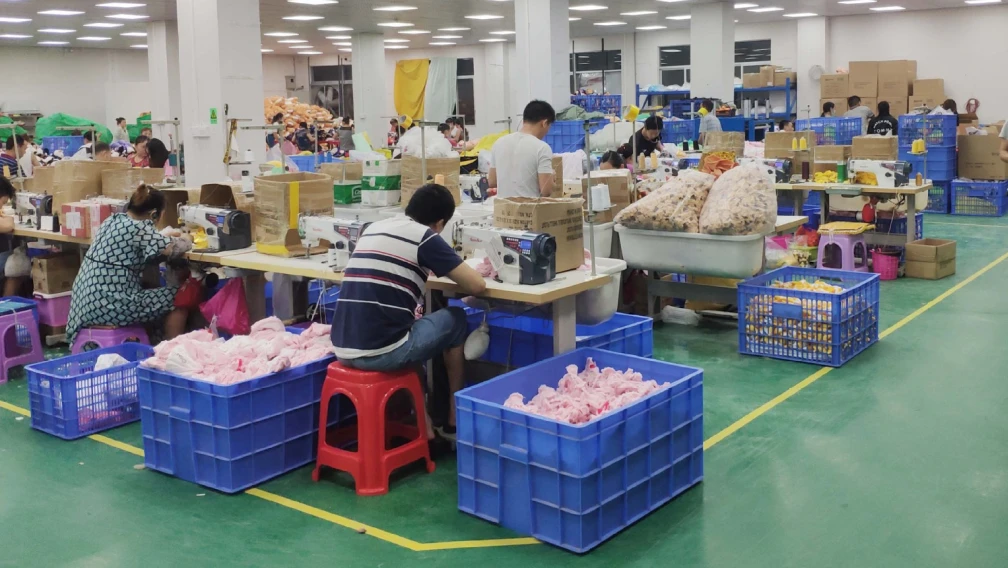
Labor minutes dictate factory assembly costs. Weighted plush toys introduce multiple new steps to the assembly line that do not exist in standard plush manufacturing.
The Double-Pouch Containment System
Factories cannot pour loose glass beads directly into a plush shell; the friction would shred the seams from the inside, and any small gap would result in a leak. Instead, workers must sew dedicated non-woven fabric pouches, manually weigh the exact dosage of beads on a digital scale, pour the beads into the pouch, and seal the pouch using an ultrasonic welder or a double-overlock stitch. Premium models utilize a double-pouch system (a bag within a bag) for safety redundancy. Each pouch represents additional fabric consumption and discrete sewing minutes.
Baffling and Hand-Stuffing
To prevent the 3-pound mass from sinking entirely to the bottom of the toy, pattern engineers design internal baffles—fabric walls that lock the weight pouches into specific zones (e.g., the paws, the chest, or the lower abdomen). Workers must manually insert these heavy pouches into the correct baffles and then hand-pack PP cotton tightly around them to hide the hard edges of the pouch. Finally, the closure seam must be hand-sewn using a reinforced ladder stitch with high-tensile nylon thread to withstand the outward pressure of the weight. This manual handling increases the assembly time per unit by up to 300 percent compared to automated PP cotton injection.
Outer Fabric and Structural Upgrades
A standard 150 GSM plush fabric will tear under the kinetic load of a 3-pound internal weight during normal use or regulatory drop testing. Upgrading the outer shell is a mandatory cost.
Factories specify high-density fabrics ranging from 300 GSM to 400 GSM for weighted items. Velboa, PV fleece, and heavy Minky are standard choices. To prevent the knit fabric from stretching and sagging under the gravitational pull of the beads, a secondary woven backing layer is often fused to the plush fabric before the panels are laser-cut. This backing stabilizes the textile but adds material and lamination costs to the BOM. Additionally, factories replace standard cotton thread with heavy-duty bonded nylon thread and increase the stitches-per-inch (SPI) density on all load-bearing seams.
Safety Compliance and Laboratory Testing Fees
Weighted toys face aggressive mechanical testing under international toy safety regulations, specifically ASTM F963 in the United States and EN 71 in Europe.
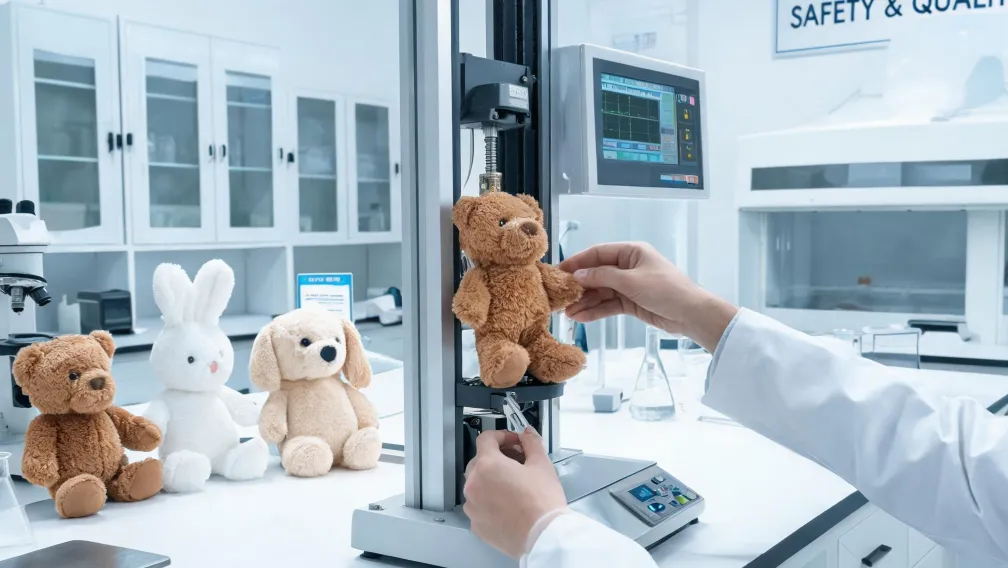
The critical compliance barrier is the mechanical drop test. The laboratory drops the weighted toy from a specified height onto a hard surface. If the kinetic energy causes a seam to burst and exposes the internal beads, the product fails instantly due to choking hazards. Buyers must absorb the cost of third-party laboratory testing (via SGS, Intertek, or Bureau Veritas) for every bulk production batch. Furthermore, the weighting agents themselves (especially PE pellets) require chemical screening to certify the complete absence of heavy metals, restricted phthalates, and lead. Budgeting $800 to $1,500 for a comprehensive suite of third-party lab reports per design is standard industry practice.
Freight Economics: Actual Weight vs. Dimensional Weight
International freight radically alters the final landed cost of weighted plush toys. Standard plush toys are lightweight and bulky, meaning ocean and air carriers bill based on volumetric weight (CBM). Weighted plush flips this equation: the actual physical gross weight exceeds the volumetric weight.
A standard 40-foot High Cube (40HQ) ocean container holds a maximum payload of approximately 20,000 to 22,000 kilograms (44,000 to 48,000 pounds), dictated by international highway weight limits for the trucking chassis that carries the container from the port. If a buyer orders 15,000 toys weighing 3 pounds (1.36 kg) each, the total cargo weight is 45,000 pounds (20,400 kg). This single order will maximize the legal weight limit of the container, even if the container is only physically half-full. Buyers must calculate their freight accruals based on actual tonnage rather than assuming they can pack a container to the ceiling as they would with standard plush. Consequently, the freight cost per unit increases sharply.
Value Engineering: How to Optimize the Budget
If the initial quotation exceeds the target budget, B2B buyers can apply value engineering strategies to reduce the FOB price without compromising safety or tactile quality.
- Targeted Weight Zones: Instead of baffling weight throughout the entire body and limbs (which requires high labor minutes), isolate the weight into a single, flat pouch located exclusively in the base of the toy. This allows the toy to sit upright naturally and reduces the internal sewing complexity.
- Hybrid Filling Ratios: Reduce the glass microbead weight slightly and increase the dense PP cotton ratio. A toy engineered to be 2.2 pounds rather than 3 pounds still provides significant sensory feedback but drastically reduces material costs, seam stress, and ocean freight tonnage.
- Simplify the Outer Pattern: Weighted toys are already expensive to manufacture; combining a heavy internal structure with a highly complex, multi-colored outer character pattern compounds the labor cost. Simplifying the character design to feature fewer fabric panels and relying on flat, high-density facial embroidery keeps the sewing time manageable.
Initiating Your Weighted Plush Sourcing Strategy
Launching a weighted plush line requires a manufacturing partner with proven expertise in heavy-duty seam construction, internal pouching systems, and kinetic drop-test compliance. Factories accustomed only to standard carnival prizes will experience high defect rates when attempting to handle high-density glass beads.
When submitting your tech pack, clearly define the exact target weight in grams or pounds, your preference for glass or plastic beads, and your intended retail market for compliance routing. Review our engineering specifications and material capabilities in the weighted plush toys section. If you are adapting an existing IP into a weighted format, our team can guide the structural conversion through our custom plush animals prototyping workflow, providing an itemized BOM and freight analysis prior to sampling.
FAQ
Glass microbeads are more expensive per kilogram than plastic PE pellets. Additionally, glass beads require specialized sourcing to ensure they are spherical, dust-free, and non-toxic. However, because they are denser, you use less volume of glass to reach the target weight, which allows the toy to remain soft and plush.
The MOQ for weighted plush is typically 500 to 1,000 units. This is slightly higher than standard plush because the factory must meet the bulk purchasing minimums set by the glass or plastic bead suppliers, and specialized heavy-duty backing fabrics often require larger minimum dye runs.
Labor costs increase because weighted agents cannot be injected using automated air-nozzles. Workers must manually weigh the beads, sew and seal internal containment pouches, hand-stuff the PP cotton around the pouches, and execute a heavy-duty reinforced closure seam by hand to withstand the internal weight.
You can optimize costs by reducing the overall target weight (e.g., dropping from 3 lbs to 2.2 lbs), consolidating the weight into a single base pouch rather than baffling it through the limbs, and using a simplified outer character pattern to offset the increased internal labor time.
Standard plush ocean freight is billed by physical volume (CBM), as the toys are light and take up space. Weighted plush is billed by actual gross weight. A bulk order of weighted toys will quickly hit the legal road weight limits of a shipping container, meaning you will pay maximum freight container costs even if the container is only half full physically.
Yes. The heavy mass exerts massive kinetic energy on the seams when dropped. Toys must undergo rigorous third-party mechanical drop testing (under ASTM F963 or EN 71 standards) to certify that seams will not burst and expose the internal beads, which would create an immediate choking hazard.